Quick answer
A tie-layer resin is a thin adhesive resin (typically 5–15 µm, or 3–8% of film thickness) coextruded between a polyolefin skin and a polar barrier such as EVOH or polyamide. It has a dual structure — a polyolefin backbone for the skin side and grafted polar groups for the barrier side — so the two incompatible layers stay bonded through converting, filling and shelf life.
Values already published on this page · Reviewed by the POLYVALA technical team · Updated November 2026
A tie-layer resin is the thin adhesive layer that holds a multilayer film together. It is not a barrier, not a structural skin and not a cheap substitute for either: it is the only reason a polyethylene skin will stay bonded to an EVOH or polyamide barrier through extrusion, converting, filling and shelf life. If you have ever seen a pouch delaminate at the seal, or watched a coextruded film split into separate sheets at the die, you have seen what happens when this layer is specified badly. This guide explains what tie resins are, what they are made of, where they sit in the structure, and which numbers actually matter when you qualify one. Start with our tie-layer and compatibilizer range if you want to see the grades alongside this article.
1. The short answer: what a tie layer is
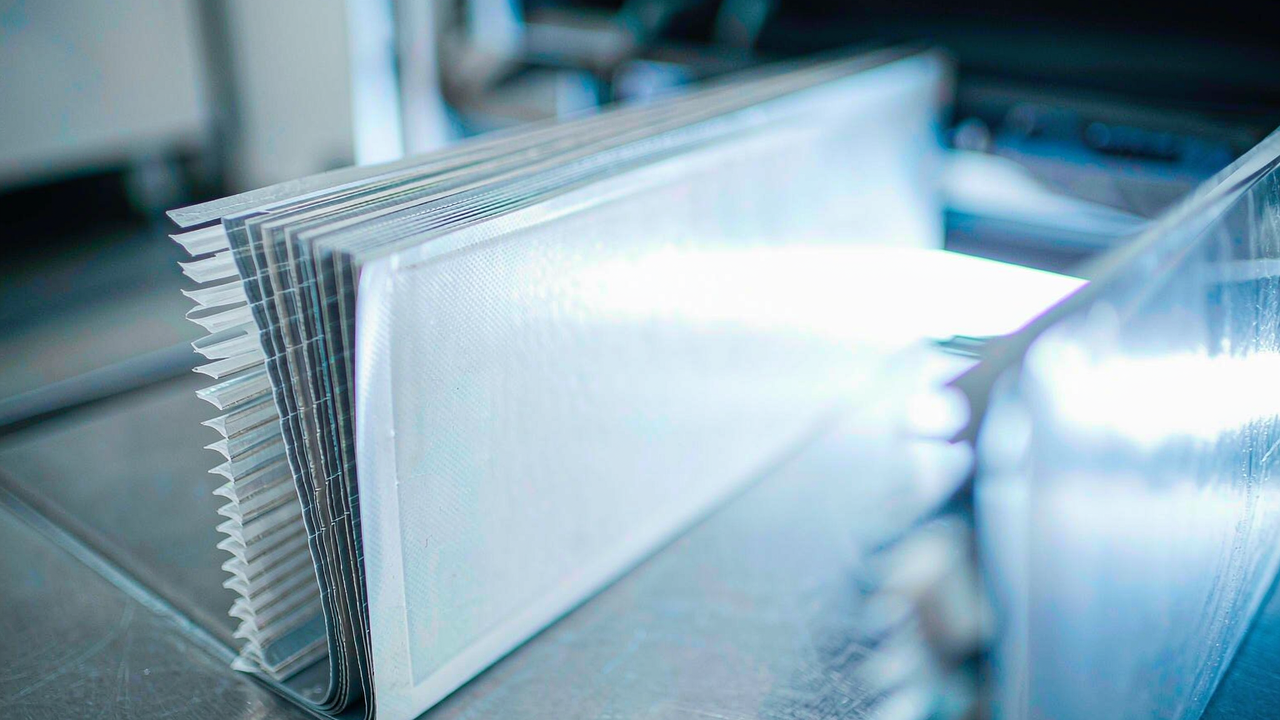
A tie layer (also called an adhesive layer, bonding layer or compatibiliser layer) is a thin extruded resin placed between two otherwise incompatible polymers in a coextruded structure. Its job is purely interfacial: it must wet both neighbours, develop adhesion to each, and stay bonded through downstream stress. Typical tie layers are 5–15 µm, often 3–8% of total film thickness — far thinner than the PE skins or the barrier core, but decisive for whether the laminate survives.
The chemistry is deliberately dual-natured. A polyolefin backbone gives the tie resin compatibility with PE or PP skins; polar functional groups grafted or copolymerised onto that backbone give it affinity with polar barriers such as EVOH, polyamide, PET or ionomer. Without that bridge, the layers simply peel apart. The same compatibilising principle also applies inside a compound — see our note on common resin abbreviations for how these families are named.
2. Why PE and EVOH do not stick on their own
Polyethylene is non-polar, chemically inert and has a low surface energy. EVOH is the opposite: its vinyl alcohol groups form a dense hydrogen-bonded network, which is exactly what makes it such an effective oxygen barrier but also makes the surface highly polar and moisture-sensitive. Coextrude the two directly and there is no thermodynamic driving force for adhesion — the interface is weak from the moment the melt cools, and it gets weaker under humidity, retort or flexing.
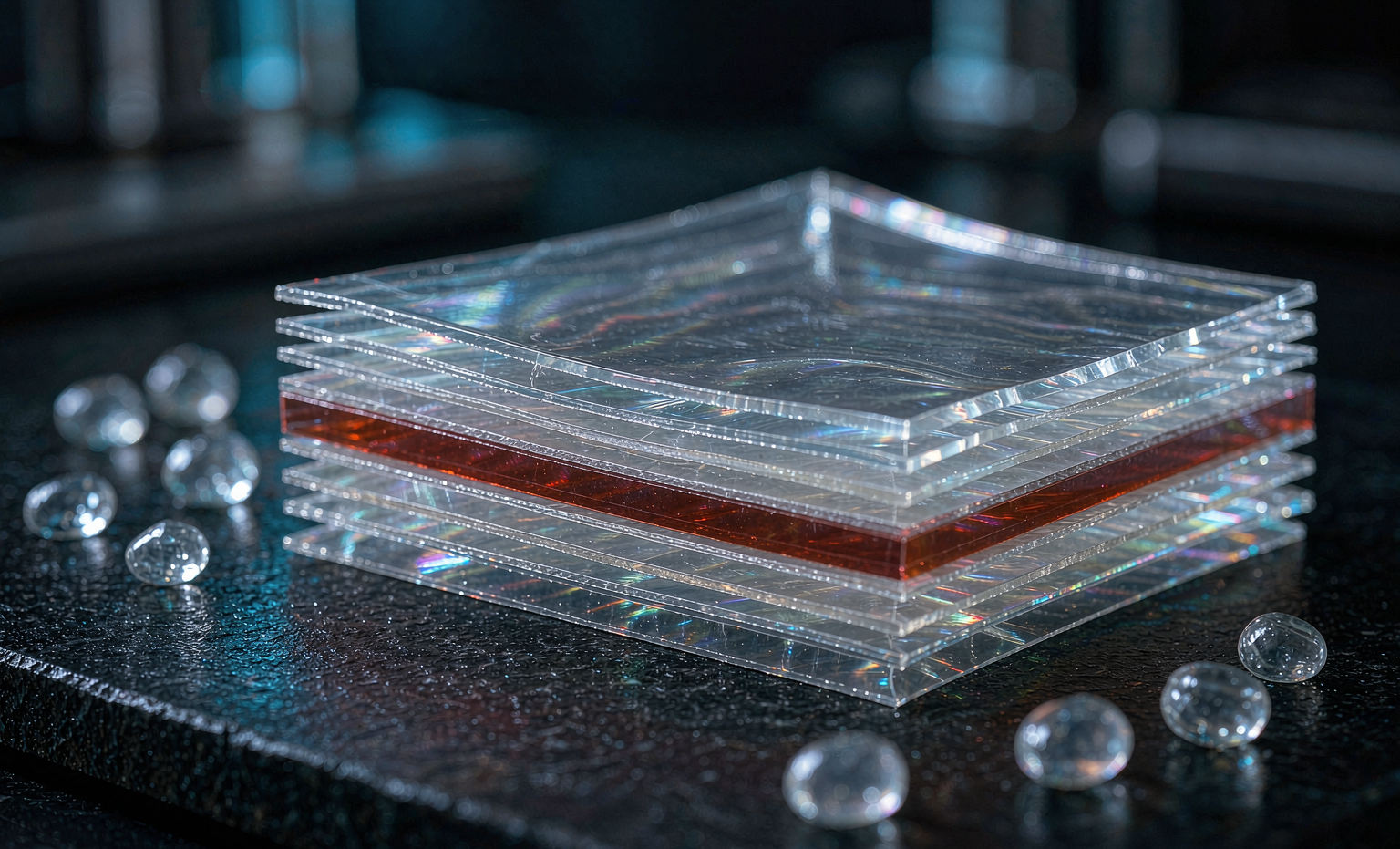
This is why every practical high-barrier structure uses a symmetrical sandwich: PE / tie / EVOH / tie / PE. The barrier resin choice and the tie resin choice are one decision, not two. Our EVOH barrier resin selection guide covers how ethylene content drives OTR and processing; the EVOH grade range and a representative grade such as EV2951F show the barrier side of that pairing. Choosing a 32 mol% grade for retort, for example, changes the thermal history the tie layer has to survive — see the 32 vs 44 mol% comparison for the published melting-point data.
3. What tie resins are actually made of
Three chemistries dominate commercial tie layers, and they are not interchangeable:
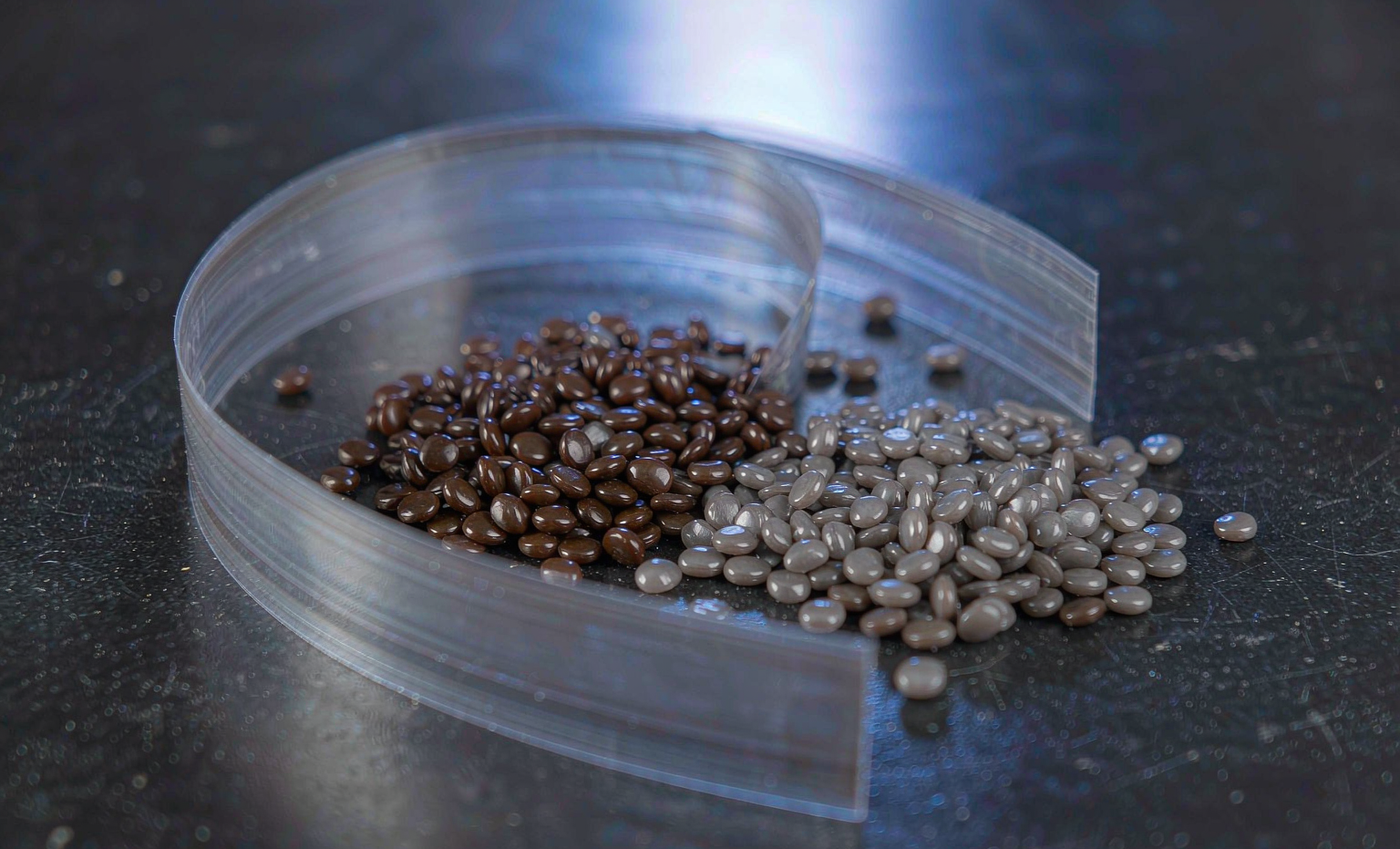
- Maleic-anhydride-grafted polyolefins (PO-g-MAH). A PE, PP or elastomer backbone with grafted anhydride groups. The anhydride can hydrogen-bond or react with the polar barrier surface; graft level and backbone MFR are the two specification levers. These are the most common choice for PE / EVOH structures.
- Acid and acrylate copolymers. EAA and EMAA, EMA / EBA and similar polar copolymers bond well to foil, paper, PET and polar substrates and are widely used in extrusion coating. A representative grade is EAA 3330; our article on EAA / EMAA in multilayer packaging goes into the chemistry.
- Ionomers and elastomer-modified blends. Ionomer resins bring hot-tack, puncture resistance and sealability; POE elastomers are sometimes blended into a tie formulation to add toughness or low-temperature flexibility, particularly where the package is deep-drawn or frozen.
Whichever chemistry you choose, ask for the functional-group content (graft level or acid content), the base resin and the recommended substrate pairing. A data sheet that lists only density and MFR is not enough to qualify an adhesive layer — our guide to reading a TDS and COA explains which fields to insist on.
4. Where the tie layers sit in a five-layer structure
A standard barrier film reads, from outside to inside: PE skin / tie / EVOH / tie / PE sealant. There are two tie layers because EVOH has two faces, and each face needs its own bridge to a polyolefin. Seven-layer and nine-layer structures add more skins or a recycled-content core, but the rule is unchanged: every polar/non-polar interface needs a tie layer, and the tie resin must be compatible with both neighbours at that interface.
Layer order matters as much as chemistry. A tie resin designed for extrusion coating onto foil may not survive the residence time and temperature of a blown-film coextrusion line; a grade specified for PE / EVOH will not necessarily bond to PET or polyamide. Grades such as BYNEL 21E787 (PET / polyamide structures) and LOTADER 4210 (extrusion coating) exist precisely because the substrate pairing changes. Retort grades such as TX8030 are qualified for the higher temperatures and moisture exposure of sterilised packaging.
5. Real tie grades and the numbers published for them
The table below reproduces the property values already published on the individual product pages in our catalogue. It is a starting point for shortlisting, not a comparison chart: test methods, conditions and suppliers differ, so values should not be compared across manufacturers without checking the original TDS. Where a value has not been published for a grade we show an em dash rather than estimating it.
| Grade (linked) | Density g/cm³ | MFR g/10 min | Tm °C | Vicat °C | Tensile MPa | Elongation % | Flexural MPa |
|---|---|---|---|---|---|---|---|
| HX8290 | 0.94 | 70 | 85 | 40 | 6 | 700 | 30 |
| LX4110 | 0.94 | 5 | 105 | 78 | 11 | 650 | 140 |
| 18211 | 0.95 | 3.5 | 75 | 51 | — | — | — |
| 18215 | 0.95 | 4 | 75 | — | — | — | — |
| 18342N | 0.93 | 3.5 | 125 | 110 | 20 | 600 | — |
| OE850 | 0.91 | 7.5 | 104 | 89 | — | — | — |
| 18300 | 0.91 | 2.3 | 120 | 85 | — | — | — |
Two things are worth reading out of that table. First, the MFR spread is enormous — from low-flow grades intended for stable coextrusion to very high-flow grades used where wetting and thin-layer distribution matter. Matching tie-layer MFR to the adjacent skin's rheology is what keeps the layer uniform instead of letting it break up or disappear at the edges. Second, melting point and Vicat softening temperature vary widely, which is why a grade that works on an ambient-fill pouch can fail in a retort cycle. Density alone tells you almost nothing about adhesion. Our data sources and TDS request policy explains how we handle supplier figures and what we will and will not put on a product page.
6. How to choose: six checks before you qualify a grade
| Check | What to ask the supplier | Why it decides the result |
|---|---|---|
| Substrate pairing | Which two layers is this grade designed to bond? PE/EVOH, PP/EVOH, PET/PE, foil/PE? | Adhesion is interface-specific; a grade qualified on one pairing is not automatically valid on another. |
| Process and temperature | Blown film, cast film, extrusion coating, lamination? Max melt temperature and residence time? | Graft functionality and the base resin have to survive your thermal history, and retort adds a second one. |
| MFR / rheology match | MFR at which condition (190 °C / 2.16 kg, 230 °C / 2.16 kg)? Viscosity ratio to the adjacent layer? | A large mismatch causes layer rearrangement, interfacial instability or uneven tie-layer thickness. |
| Peel strength | Bond strength to the specific barrier, dry and after ageing; test method and conditioning. | This is the actual performance metric — not density, not tensile strength of the tie resin itself. |
| Barrier and food-contact compliance | Food-contact status for the target market, overall migration limits, odour and taint data. | A technically sound adhesive is useless if it cannot be used in the intended application. |
| Supply consistency | Lot-to-lot graft level control, COA availability, minimum order quantity and lead time. | Small graft-level drift changes peel strength, so a consistent source matters more than a marginal price saving. |
Run a line trial with the exact structure, layer distribution and cycle you intend to run. Peel strength measured on a laboratory laminate rarely transfers unchanged to a production line — our TDS / COA guide covers how to read the test conditions behind each number.
7. Five mistakes we see in RFQs
- Treating the tie layer as a commodity PE. It is a functional adhesive; specifying "LLDPE, any grade" is the fastest route to delamination.
- Naming only the barrier resin. An RFQ that says "EVOH 32 mol%, 5-layer" but omits the skin resin, the tie resin and the layer ratio cannot be quoted accurately.
- Skipping the retort or filling cycle. A grade such as TX8030 exists because ambient-fill tie resins do not always survive sterilisation.
- Optimising tie-layer thickness down to save cost. Below a workable thickness the layer becomes discontinuous; the saving is small and the failure is total.
- Comparing published numbers across suppliers. The same "MFR" can be measured at different temperatures and loads. Check the method before you shortlist; see how to read a TDS.
8. What to put in the RFQ
Send the full layer structure in order, with each resin family and the target thickness or layer ratio; the barrier resin and grade (or target OTR and test conditions); the process (blown / cast / coating / lamination) and maximum melt temperature; the filling cycle (ambient, hot-fill, pasteurisation, retort temperature and time); the required peel strength and how it is measured; the application and food-contact market; and the volume, packaging and delivery destination. With that in hand we can shortlist tie grades against real data — for example a low-MFR, higher-melting option such as LX4110 versus a high-flow option such as HX8290 — and send the current TDS and sample availability for each.
9. Quick FAQ
Is a tie layer the same as an adhesive?
In a coextruded film, yes in function, but it is a thermoplastic resin extruded as a layer — not a solvent-based glue applied afterwards. It bonds in the melt, at the interface, as the structure is formed.
Can one tie resin bond PE to both EVOH and polyamide?
Sometimes, but not by default. Both are polar, yet the surface chemistry, processing temperature and moisture behaviour differ enough that grades are usually qualified per pairing. Ask for peel data on your exact barrier.
How thick should the tie layer be?
Commonly a few percent of total thickness, but the workable minimum depends on the line, the viscosity match and the layer distribution. Establish it with a trial rather than by copying a number from a different structure.
Does the tie layer affect oxygen barrier?
Not directly — the barrier comes from the EVOH or polyamide core. But a failed tie layer delaminates the structure, and a delaminated barrier film does not perform as designed. Its contribution is to keep the structure intact.
Browse the full tie-layer and compatibiliser range, or send your structure and cycle to the technical team for grade options, samples and the current TDS. Our TDS request policy sets out what documentation comes with a quotation.
About This Article
This guide is prepared by the POLYVALA technical team. All property values, test methods and compliance statements are drawn from manufacturer Technical Data Sheets (TDS) and recognized standards (ASTM, ISO). Figures must always be confirmed against the current official TDS and the lot-specific Certificate of Analysis (COA) before production qualification.
References
- Manufacturer Technical Data Sheets (TDS) for the grades referenced above.
- ASTM D1238 / ISO 1133 — Melt flow rate (MFR/MFR) of thermoplastics.
- ASTM D1505 / ISO 1183 — Density of plastics by the density-gradient technique.
- ASTM D638 — Tensile properties of plastics.
Related reading
For a grade-by-grade comparison of the three main adhesive chemistries, see our guide: Tie-Layer Compound Selection: PE-g-MAH vs PP-g-MAH vs EAA.
See also: Bondine vs Bynel vs Primacor vs Igetabond: A Tie-Layer Brand Cross-Reference — a four-brand tie-layer cross-reference.
About this article
Written by the technical team at Shanghai Polyvala Plastics, a sourcing and compounding partner for specialty polymer buyers since 2013. We check grades against manufacturer TDS and lot-specific COA rather than marketing claims. Questions about a grade or an equivalent? Request the TDS and COA, or contact our application engineers for a line-specific recommendation.
Related reading