A retort cycle is the hardest hour in a high-barrier package's life. Saturated steam at 121 °C drives water into the EVOH layer at exactly the moment the pack needs its oxygen barrier most, and the OTR figure printed on a technical data sheet says nothing about that hour — it is measured on a dry specimen at room conditions. This article explains the moisture mechanism, the three phases a retort structure goes through, which published grade numbers you can legitimately use as a starting point, and the structure and test plan that actually de-risks a retort pouch. For the wider selection framework, start with our EVOH barrier resin selection guide.
1. Why 121 °C Is a Different Problem from Normal Storage
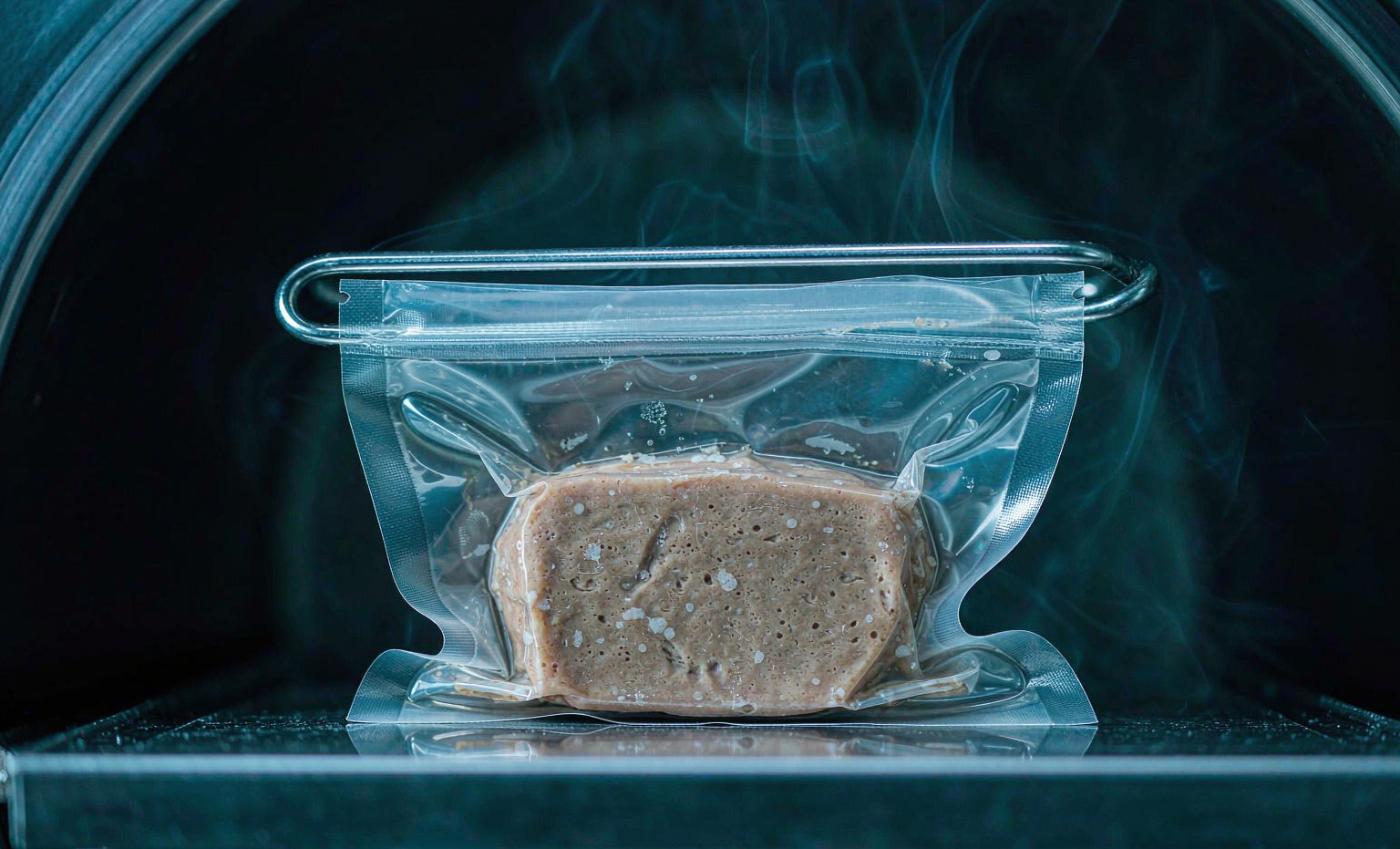
A low-acid food retort holds the package in saturated steam under pressure at around 121 °C for a cycle time set by the process authority, not by the resin supplier. Two things make that fundamentally different from warehouse storage. First, the humidity is not 65 % RH — it is saturated, and water is driven into the film from both faces under a pressure differential. Second, the package is under mechanical load at the same time: the pouch expands, the seals are stressed, and the layers shear against each other as they soften and cool.
It is worth being precise about what is not happening. The DSC melting points published for the EVOH grades on this site run from 164 °C to 190 °C, comfortably above retort temperature, so the barrier layer is not melting. The problem is moisture, not fusion. That distinction matters: changing to a higher-melting resin will not fix a retort failure, while changing the layer structure often will. Our introduction to EVOH grades and OTR covers the baseline, and the 32 vs 44 mol% comparison shows how the grade choice shifts the trade-off.
2. What Steam Does Inside the EVOH Layer
EVOH gets its barrier from a dense network of hydrogen bonds between the hydroxyl groups on the vinyl alcohol units. That network leaves very little free volume for an oxygen molecule to diffuse through. Water is small, polar and extremely good at competing for those same hydroxyl sites. As moisture enters the amorphous phase it interrupts the hydrogen bonding and plasticises the polymer: chain mobility and free volume rise, and oxygen permeability climbs with them.
This is also why the grade ranking is humidity-dependent. A low-ethylene grade carries more vinyl alcohol units — more hydroxyls, a tighter dry network, a better dry OTR — and correspondingly more sites for water to bind. A higher-ethylene grade starts with a weaker dry barrier but is less moisture-sensitive. Under retort conditions the dry advantage of the low-ethylene end can narrow or even invert for a period, which is exactly why a catalogue OTR number should never be used on its own to qualify a sterilised package. The four EVOH ethylene-content steps on this site make that progression visible.
Moisture arrives from two directions. It permeates through the polyolefin skins during the cycle, and it can diffuse from a wet product on the inside after filling. The skins are therefore not merely structural: their thickness and permeability set how fast water reaches the barrier and how fast it can leave again. Tie layers matter here too, because a wet, hot interface is where adhesion is most likely to fail — see our tie-layer explainer and the tie-layer and compatibilizer range.
One useful piece of good news: the effect is physical, not chemical degradation. As the structure dries, water desorbs and hydrogen bonding re-forms, so barrier performance recovers. "Temporary" is not the same as "irrelevant" though — the elevated-OTR window sits at the beginning of shelf life, and a shelf-life model that assumes the dry value from day one will under-predict oxygen ingress.
3. The Three-Phase Timeline
Retort behaviour is a timeline, not a single number. Treat these as three separate test conditions and state which one each measurement refers to.
- During the cycle. Saturated steam, elevated temperature and pressure. Water uptake is at its fastest and the film is simultaneously under mechanical stress. OTR measured on the fly is rarely practical, so this phase is normally captured by the finished-package test rather than by a flat-film instrument.
- Immediately after cooling. The moisture is still in the EVOH. This is typically the worst measured barrier point, and often the worst peel strength at the tie interfaces as well. If you only ever measure here, you will specify a structure for the wrong condition.
- Recovery. Water diffuses back out through the skins and OTR falls toward the dry reference. The interval depends on skin thickness and permeability, layer order, storage temperature and ambient humidity — which is precisely why it has to be set by your own protocol rather than copied from a supplier's brochure. Define time zero and the recovery interval explicitly in the test report.
Two practical consequences follow. First, request OTR at your own temperature, RH and layer thickness, after your own cycle, at a stated recovery point; a value without those four qualifiers is a screening number only. Second, when you model shelf life, integrate the transient rather than assuming the dry value from day one. Our guide to reading a TDS and COA explains how to tell a conditioned test value from an unqualified one.
4. Published Grade Data: A Starting Point, Not a Retort Value
The table below is built from the grade pages on this site for one family — Chang Chun Petrochemical's EVASIN range — so the four rows share a single test basis. These are catalogue reference values quoted on the individual product pages; none of them is a post-retort measurement.
| Grade (ethylene content) | Published OTR, reference basis | Density (g/cm³) | MFR (g/10 min) | DSC melting point |
|---|---|---|---|---|
| EV2951F (29 mol%) | 0.3 cc·20µm/m²·day·atm | 1.2 | 3.0 | 188 °C |
| EV3251F (32 mol%) | 0.4 cc·20µm/m²·day·atm | 1.19 | 1.6 | 183 °C |
| EV3851F (38 mol%) | 0.7 cc·20µm/m²·day·atm | 1.17 | 1.6 | 173 °C |
| EV4405F (44 mol%) | 1.5 cc·20µm/m²·day·atm | 1.14 | 5.5 | 165 °C |
Read that table as a dry-state ranking and a processing guide, nothing more. Notice the direction: as ethylene content rises from 29 to 44 mol%, the reference OTR rises and the melting point falls from 188 °C to 165 °C. The lower-ethylene EV2951F and EV3251F are the high-barrier candidates; EV3851F and EV4405F trade some of that barrier for a wider, cooler processing window. What the table cannot tell you is how much of the low-ethylene advantage survives your particular sterilisation cycle.
Other suppliers on the site publish the same kind of data in different units and at stated conditions — for example Kuraray L171B and E105B, Nippon Gohsei DT2904RB and A4412B, Chuanwei EW-3201 and Wanhua EV-3228. Some quote OTR at 20 °C / 65 % RH, others include the film thickness in the unit, and the test bases are not the same. Do not compare those numbers across manufacturers: the test conditions are not the same. Ask every supplier for OTR at your conditions, on your layer thickness, after your cycle.
5. Structure Design: Six Levers That Actually Protect the Barrier
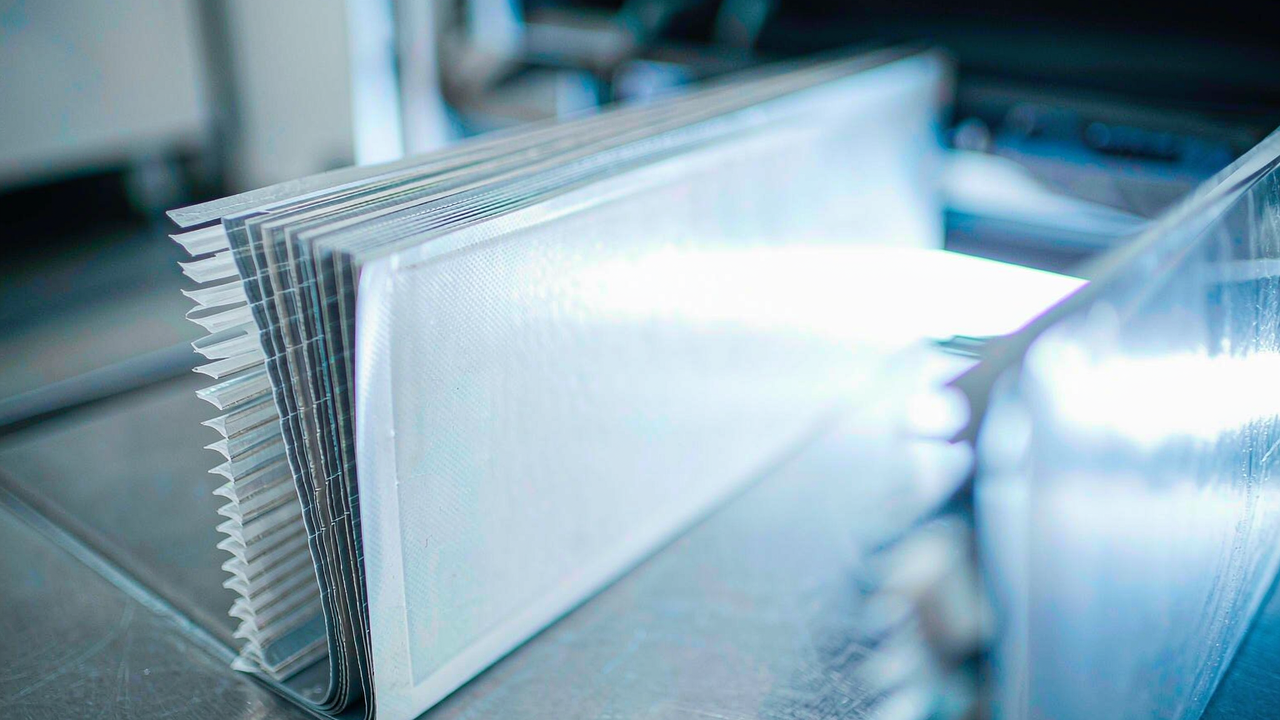
Since the mechanism is moisture transport, the fix is structural. A symmetric PP / tie / EVOH / tie / PP stack is the usual starting point for a retort pouch: the polyolefin skins keep the barrier away from both the wet product and the ambient air, and the tie layers hold the stack together through the cycle. From there, these are the levers worth evaluating in a trial.
| Design lever | What it changes | Why it matters at 121 °C | How to verify |
|---|---|---|---|
| Skin thickness and resin | Rate of moisture ingress and egress | Thicker, less permeable skins slow water uptake and shorten the recovery window | Compare OTR at several recovery points for two skin gauges |
| EVOH layer thickness | Dry-state barrier headroom and cost | Extra headroom absorbs part of the transient loss, but cannot substitute for moisture control | Measure actual layer thickness from a cross-section, not the nominal setting |
| Symmetric vs asymmetric stack | Which side the barrier sees as the drier one | A wet product on one face argues for putting the drier side toward the EVOH | Test both orientations after the same cycle |
| Tie resin on both faces | Interfacial adhesion when hot and wet | Delamination destroys the barrier even if the EVOH itself is intact | Peel strength before, immediately after, and after recovery |
| Ethylene content of the EVOH | Dry barrier, moisture sensitivity, processing window | Lower ethylene gives more dry barrier but more moisture uptake | Run the same structure with two grades and compare the full timeline |
| Moisture-management layers | Local humidity around the core | Scavenging or desiccant layers can reduce the water load on the EVOH | Confirm food-contact compliance and re-check cost per thousand packs |
Tie selection deserves its own trial line. Grades such as SK BONDINE TX8030 and HX8290 are used in PA / EVOH / PE stacks, while Dow BYNEL 21E787 and the EAA / EMAA range — including EAA 3330 — cover adhesion to polar substrates and foil. Where seal integrity under hot-wet conditions dominates, ionomer resins and EMA / EBA copolymers are worth including in the comparison. The chemistry is discussed in our EAA and EMAA adhesion article.
6. Choosing the EVOH Grade for a Retort Structure
Grade choice is a system decision. In dry conditions the low-ethylene end wins on OTR; after a retort cycle some of that advantage is lost to moisture uptake, so the question becomes whether your skins and recovery interval let the advantage come back in time to matter for shelf life. If they do, 29–32 mol% is the usual starting point. If the cycle is long, the skins are thin, or the product is wet, the more moisture-tolerant 38–44 mol% end can be the safer specification even though its catalogue OTR looks worse.
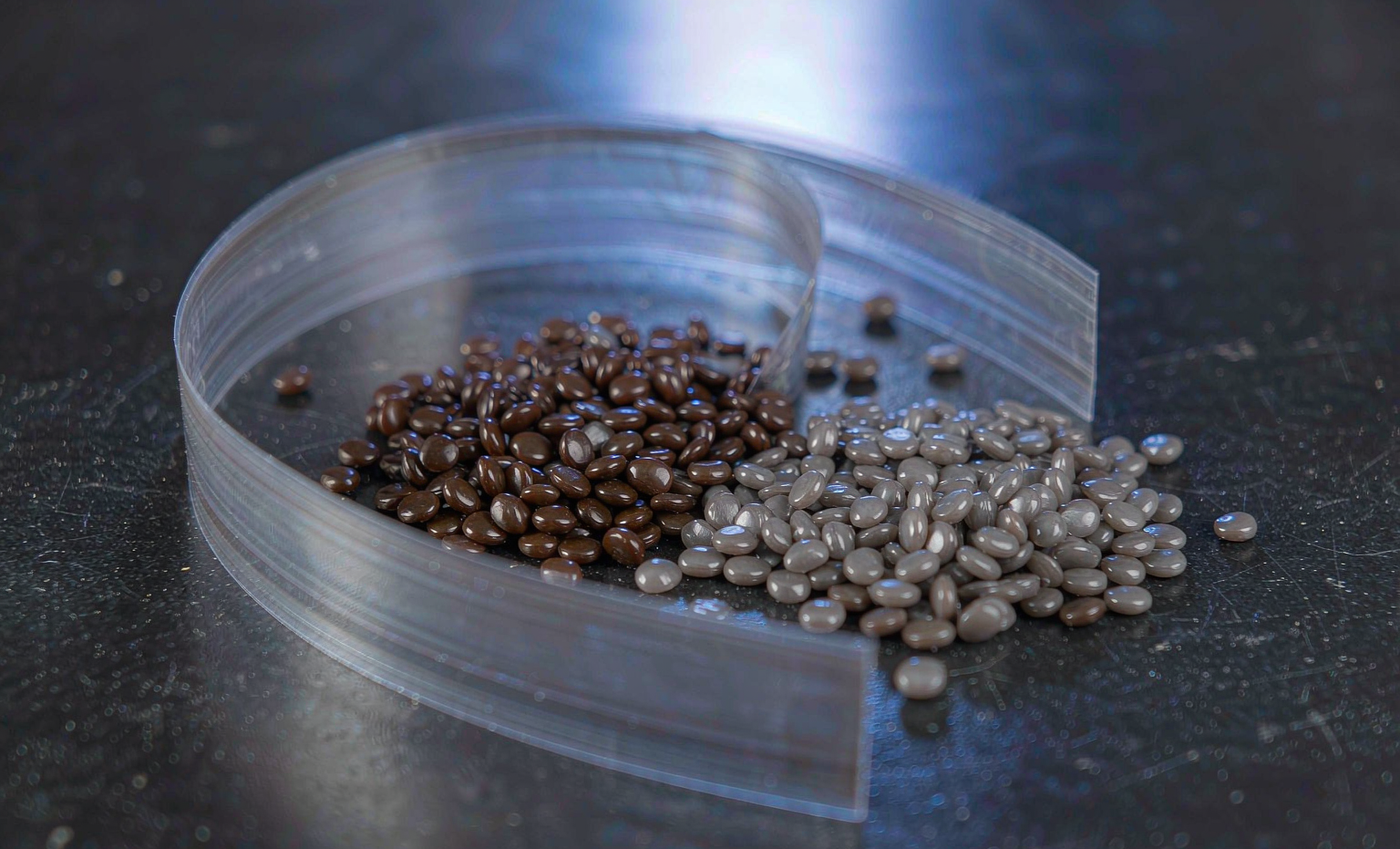
Processing constrains the choice too. The melting points in the table above span 165–188 °C, so the barrel profile, die and residence time have to be set per grade; low-ethylene grades run hotter and have a narrower coextrusion window. MFR matters for layer uniformity: the EVASIN family on this site runs from 1.6 to 5.5 g/10 min, while Wanhua EV-3228 is listed at 28 g/10 min. A large viscosity mismatch against the adjoining tie resin disturbs layer distribution, and an uneven barrier layer is the last thing a retort structure can afford. Keep the resin sealed until use and follow the supplier's drying guidance — EVOH is hygroscopic, and starting with wet pellets adds moisture you will only have to remove again.
If your application is a sterilised medical or optical part rather than a food pouch, the material family changes: the COC and COP buyer's guide covers steam sterilisation in that context. For barrier packaging, the full barrier materials range gives an overview of the adjacent options.
7. How to Test: Finished Package, Not Flat Film
The single most common qualification mistake is approving a retort structure from flat-film OTR data. A flat coupon has no seals, no corners, no thermoformed thinning, no product contact and no autoclave history. Test the converted package, through the real cycle, and record the whole stack of conditions.
- Cycle: time at temperature, temperature, pressure profile, load pattern and cooling method — the actual production recipe, not a laboratory shortcut.
- Time points: before the cycle, immediately after cooling, and at one or more defined recovery intervals. State how time zero is defined.
- Measurements: OTR at a stated temperature and RH, peel strength at both tie interfaces, seal strength, delamination and visual defects. Barrier and adhesion belong in the same report.
- Structure: measure real layer thicknesses from a cross-section after forming, since thermoforming thins the barrier where it is needed most.
- Traceability: resin lot numbers for EVOH and both tie resins, plus the current TDS, SDS and lot-specific COA for each. Our TDS request policy sets out what documentation accompanies a quotation.
Ask the supplier to state the OTR test basis in writing — temperature, RH, film thickness and conditioning — and treat any number without those as indicative only. The TDS and COA guide lists the checks our QC team applies before a batch is released.
8. What to Put in the RFQ
Most retort enquiries we receive fail on the same missing detail: the cycle. Without it, a grade recommendation is a guess. A workable RFQ should state:
- Retort cycle: temperature, time at temperature, pressure and cooling profile; also hot-fill or aseptic filling conditions if relevant
- Product characteristics: water activity, pH, fat content and whether the product contacts the barrier side directly
- Target shelf life and the OTR you need, with test temperature, RH and film thickness
- Full layer order, total gauge and intended EVOH and tie layer thicknesses, plus whether the stack is symmetric
- EVOH ethylene content and MFR requirement, including the MFR test condition
- Tie-layer resin specified on both sides of the barrier core, and the substrates it must bond to
- Food-contact compliance for the destination market
- Package-level test protocol, including the recovery interval and post-retort peel criteria
- Documentation required: current TDS, SDS, lot-specific COA
- Sample quantity, lot traceability and the target date for the first converting trial
Send that list with your structure drawing and we can come back with two or three candidate grades rather than a catalogue dump. Browse the EVOH range and the tie-layer range first, or contact the technical team directly.
9. Quick FAQ
Does EVOH melt at 121 °C?
No. The DSC melting points published for our EVOH grades run from 164 °C to 190 °C. The barrier loss in a retort is moisture-driven, not a melting problem — which is why the fix is structural.
Is the retort damage permanent?
Largely not. Water desorbs as the pack dries and the hydrogen-bond network re-forms, so OTR falls back toward the dry reference. But the elevated-OTR window occurs at the start of shelf life and must be measured, not assumed away.
Should I always specify 29 or 32 mol% for maximum retort barrier?
Not automatically. Those grades have the best dry OTR and the greatest moisture sensitivity, so their advantage depends on skin thickness, cycle severity and recovery time. The 32 vs 44 mol% comparison works through that trade-off in detail.
Can I drop the tie layers if I use polypropylene skins?
No. EVOH does not bond to polyolefins on its own, and a wet hot cycle is the hardest adhesion case. Our tie-layer guide explains the chemistry, or you can compare TX8030 and BYNEL 21E787 grade data directly.
Can I use the catalogue OTR in a shelf-life calculation?
Not for a retort pack. Catalogue values are dry/reference measurements under the supplier's own conditions. Measure the finished package after the real cycle at a stated recovery point, and ask your supplier for OTR at your temperature and RH. Our selection guide covers the wider framework and our documentation policy explains what we supply with a quote.
For grade options, samples and the current TDS, send your structure and retort cycle to the technical team. You can also browse the full EVOH range or read the EVOH barrier resin selection guide for the full decision framework.
About This Article
This guide is prepared by the POLYVALA technical team. All property values, test methods and compliance statements are drawn from manufacturer Technical Data Sheets (TDS) and recognized standards (ASTM, ISO). Figures must always be confirmed against the current official TDS and the lot-specific Certificate of Analysis (COA) before production qualification.
References
- Manufacturer Technical Data Sheets (TDS) for the grades referenced above.
- ASTM D1238 / ISO 1133 — Melt flow rate (MFR/MFR) of thermoplastics.
- ASTM D1505 / ISO 1183 — Density of plastics by the density-gradient technique.
- ASTM D638 — Tensile properties of plastics.
About this article
Written by the technical team at Shanghai Polyvala Plastics, a sourcing and compounding partner for specialty polymer buyers since 2013. We check grades against manufacturer TDS and lot-specific COA rather than marketing claims. Questions about a grade or an equivalent? Request the TDS and COA, or contact our application engineers for a line-specific recommendation.