Quick answer
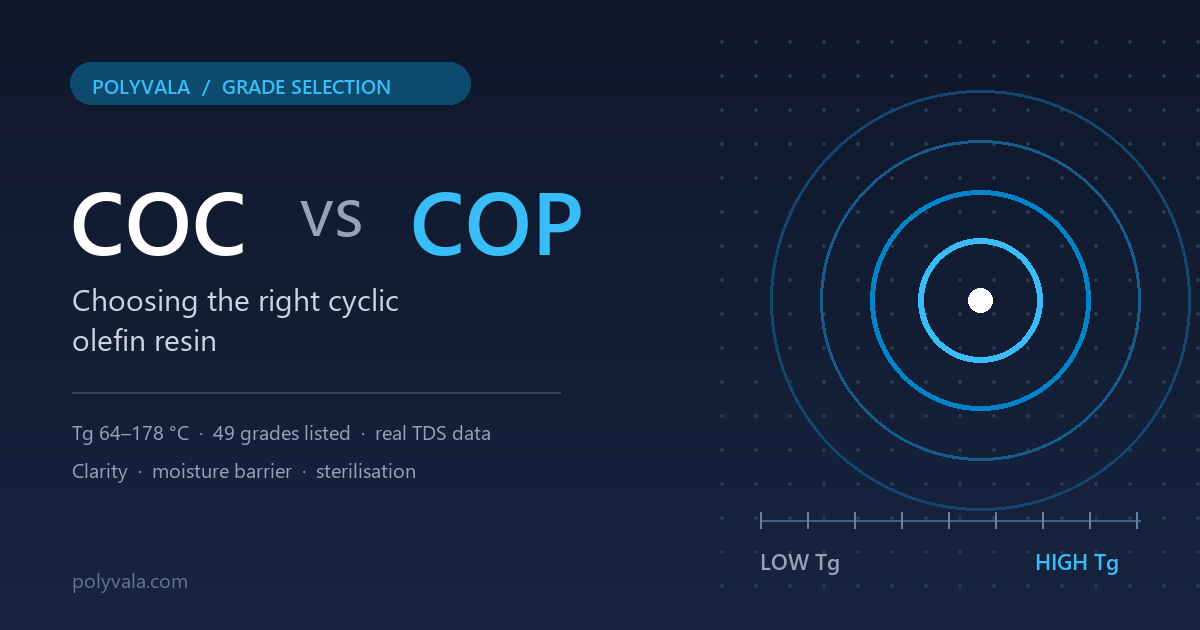
COC and COP are both glass-clear, amorphous cyclic olefin resins, but they are made by different routes: COC is an ethylene/norbornene copolymer, COP a hydrogenated ring-opening polymer. Because both are amorphous, Tg — not Tm — sets the heat window. Across the 49 grades listed on POLYVALA, 43 publish a Tg spanning 64–178 °C.
Values already published in this article · Reviewed by the POLYVALA technical team · Updated November 2026
COC and COP are usually quoted together, and they look almost identical in the pellet drum: water-clear, stiff, amorphous, and very low in moisture pickup. But they are made by two different chemistries, and the difference shows up in heat resistance, optical behaviour, processing and price. Buyers who ask simply for “cyclic olefin resin” often get a sample that is technically a COC when the tool needed a COP — or a 78 °C grade when the part has to survive sterilisation. This guide sets out what actually differs, which numbers to specify, and how to shortlist from the 49 COC/COP grades now listed on POLYVALA.
COC vs COP: two routes to a similar-looking resin
Both families are amorphous, glass-clear cycloaliphatic polymers built around norbornene chemistry. The fork is how the chain is assembled:
- COC (cyclic olefin copolymer) is an addition copolymer of ethylene and a cyclic olefin such as norbornene, typically made with a metallocene catalyst. The ethylene segments break up the rigid ring structure, which gives the producer a wide, tunable glass-transition window and generally easier melt processing.
- COP (cyclic olefin polymer) is made by ring-opening metathesis polymerisation of norbornene-type monomers followed by full hydrogenation. The backbone is essentially all cyclic, with no ethylene comonomer — a route commonly chosen where very low birefringence and optical purity dominate.
Both are amorphous (so no crystalline melting point — Tg, not Tm, is the number that matters), both absorb very little water, and both are used where glass-like clarity has to coexist with chemical purity and dimensional stability. In our catalogue the COC side is TOPAS, Mitsui APEL, ACOC and TopOlefin TAMT/SOOC; the COP side is JSR ARTON and ZEON ZEONEX / ZEONOR.
Start with Tg — it sorts the whole catalogue
Glass transition temperature sets the usable heat window, the sterilisation route, dimensional stability in service, and how hot the tool has to run. It is the first field to ask a supplier for: 43 of the 49 grades we list publish a Tg, and it spreads from 64 to 178 °C. A few real examples from our grade pages:
| Family | Grade | Tg (°C) | Where it tends to sit |
|---|---|---|---|
| COC | TOPAS 9506F-500 | 64 | lowest-Tg grade listed; film / low-heat use |
| COC | TOPAS 8007S-04 | 78 | packaging film and blends |
| COC | Mitsui APEL APL6509T / APL6015T | 80 / 145 | same family, wide heat window |
| COC | ACOC 2020 / ACOC 5050 | 80 / 142 | domestic COC options |
| COC | TOPAS 5013S-04 / 6017S-04 | 134 / 178 | optical & medical injection / highest Tg listed |
| COP | ZEONEX 5000 / 790R | 68 / 163 | optical COP range |
| COP | ZEONOR 1020R / 1420R | 102 / 136 | general optical and medical moulding |
| COP | JSR ARTON F4520 / F4540 | 164 | high-heat optical COP |
As a rough starting point — not a specification — grades below about 100 °C tend to serve film, sealant and low-temperature processing; 130–145 °C covers much of general medical and optical injection moulding; above 150 °C is where high-heat and sterilisation-resistant parts live. Always confirm against the official TDS for the exact grade, because Tg alone does not tell you whether a part survives a given sterilisation cycle.
Then check optics, moisture and barrier
Two real grade sheets from our catalogue show the parameters that usually decide the shortlist:
- TOPAS 8007S-04 (COC): Tg 78 °C, density 1.010 g/cm³, light transmission 91% at 2 mm (ISO 13468-1), water absorption 0.01% (23 °C saturated, ISO 62), water vapour permeability 0.025 g·mm/(m²·d) at 23 °C / 85% RH (DIN 53122).
- ZEONEX 690R (COP): Tg 136 °C, density 1.02 g/cm³, light transmission 92%, water absorption <0.01%, WVTR 1.0 g/m²·d; listed as steam sterilisable and medical grade with DMF (FDA No. 14084), compatible with EO, gamma, steam and hydrogen peroxide sterilisation.
One trap worth flagging: WVP and WVTR are different quantities measured under different conditions, so do not compare 0.025 against 1.0 as if they were the same test. Ask for the test standard, temperature and humidity alongside the number. For precision optics, also ask for birefringence and refractive index — COP is frequently specified there for its low birefringence, while COC is often the more forgiving, tougher and easier-processing choice. Processing differs too: TOPAS COC literature states no pre-drying is required, whereas our ZEONEX data calls for a 105 °C preheat for 4–12 hours. Do not carry a drying recipe from one family over to the other.
Match the grade to the end use
- Pharmaceutical primary packaging (blister, vial, prefilled syringe): low extractables, high purity, a defined sterilisation route, and regulatory documentation — DMF, food- or drug-contact compliance, and COA per lot.
- Optics and display (lenses, light guides, optical film): transmission, haze, birefringence, refractive index and long-term yellowing resistance.
- Diagnostics and microfluidics: clarity plus low autofluorescence, dimensional stability and bondability of the finished device.
- Film and multilayer structures: COC is commonly used as a blend or coextruded layer; match Tg and processing temperature to the PE/PP or barrier layers it runs with. For oxygen barrier specifically, see our EVOH grades guide.
What to put in the RFQ
A workable enquiry names the chemistry and the window, not just a trade name. Include:
- COC or COP, and the target Tg range (or the heat/sterilisation requirement that sets it).
- Conversion process: injection moulding, film casting/blown film, or extrusion — plus MFR if the tool is already fixed.
- Optical targets: transmission, haze, birefringence, and whether the part is measured at a defined thickness.
- Barrier target with its test condition (WVTR or WVP, temperature and RH).
- Sterilisation method and the documents required: DMF, food/drug-contact statements, COA, lot traceability, REACH/RoHS where relevant.
- Sample quantity, target MOQ, and whether an equivalent grade is acceptable if the first choice is not in stock.
If you know the process and the end use but not the exact grade, send us that window and we will narrow it to a stocked or equivalent grade, with COA and samples before any volume commitment. For the broader buying context, see our guide on sourcing polymer pellets from China.
Browse the full grade list
We list 49 COC/COP grades with published specifications, split into COC grades and COP grades under the COC / COP category. The full comparison table shows Tg, density and other specs in one view, which is the fastest way to shortlist by heat window before requesting data sheets. Use Request TDS on any grade page to get the current official data sheet for the exact lot you plan to buy.
Bottom line
Treat “COC/COP” as a family, not a product. Fix the chemistry against the optical requirement, set Tg against the heat and sterilisation route, then verify transmission, barrier and regulatory documents on the official TDS. Do that and the first sample is far more likely to be the right one.
Data on this page is compiled from public manufacturer literature accessed 2026-10-25 and from the grade records on this site. It is a selection aid, not a specification — always confirm values against the latest official TDS before ordering.
About This Article
This guide is prepared by the POLYVALA technical team. All property values, test methods and compliance statements are drawn from manufacturer Technical Data Sheets (TDS) and recognized standards (ASTM, ISO). Figures must always be confirmed against the current official TDS and the lot-specific Certificate of Analysis (COA) before production qualification.
References
- Manufacturer Technical Data Sheets (TDS) for the grades referenced above.
- ASTM D1238 / ISO 1133 — Melt flow rate (MFR/MFR) of thermoplastics.
- ASTM D1505 / ISO 1183 — Density of plastics by the density-gradient technique.
- ASTM D638 — Tensile properties of plastics.
About this article
Written by the technical team at Shanghai Polyvala Plastics, a sourcing and compounding partner for specialty polymer buyers since 2013. We check grades against manufacturer TDS and lot-specific COA rather than marketing claims. Questions about a grade or an equivalent? Request the TDS and COA, or contact our application engineers for a line-specific recommendation.
Related reading