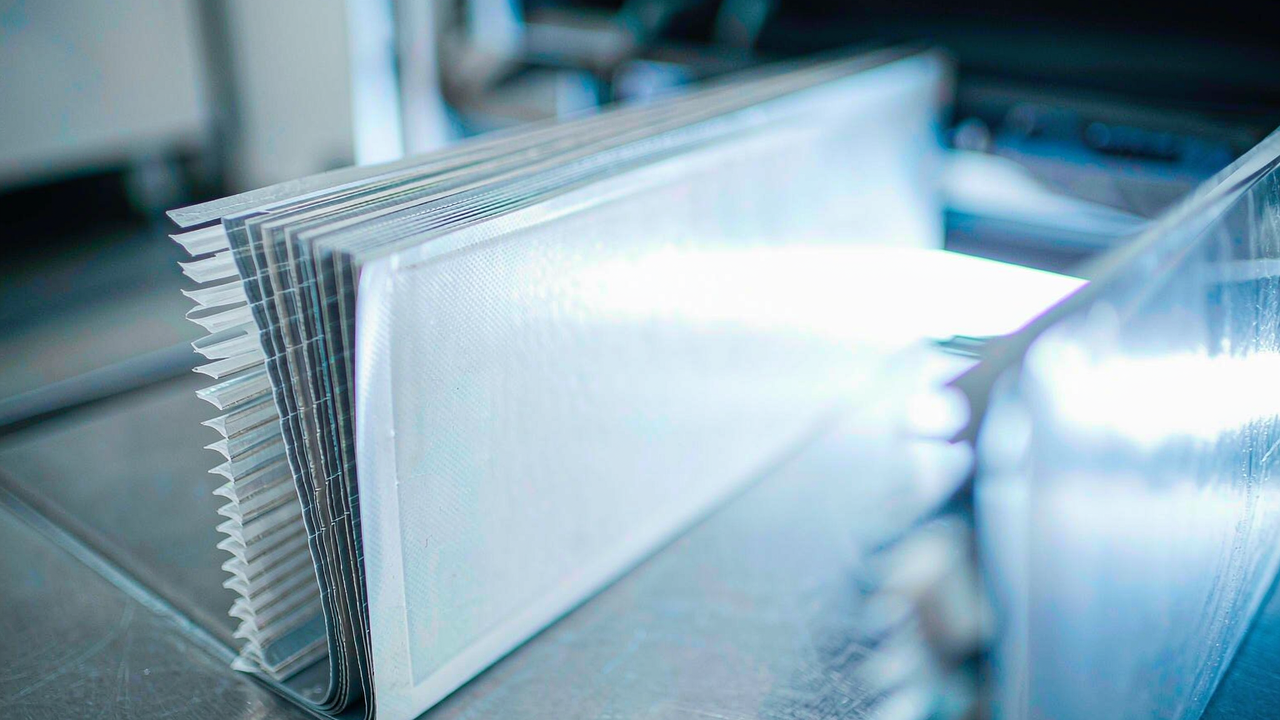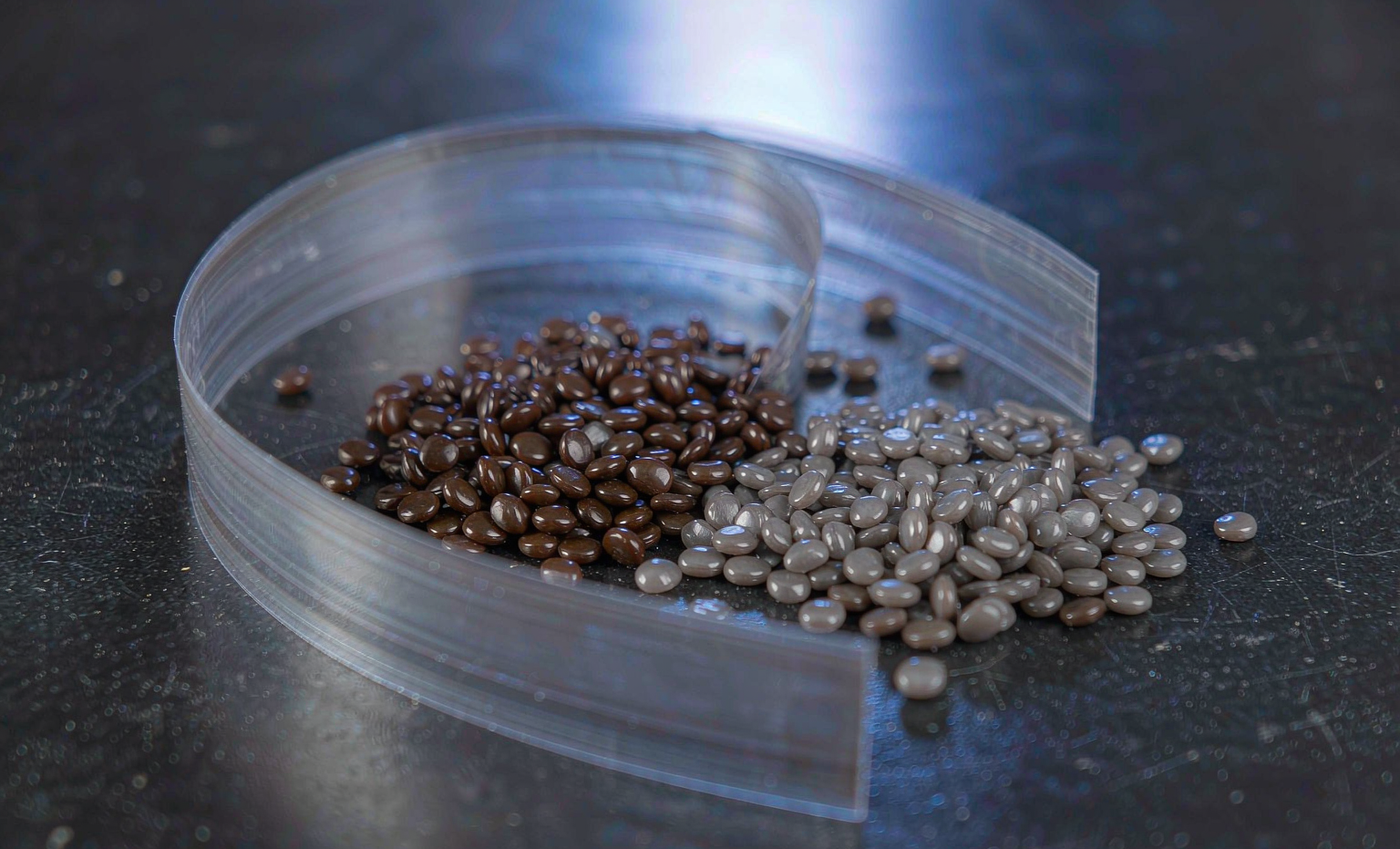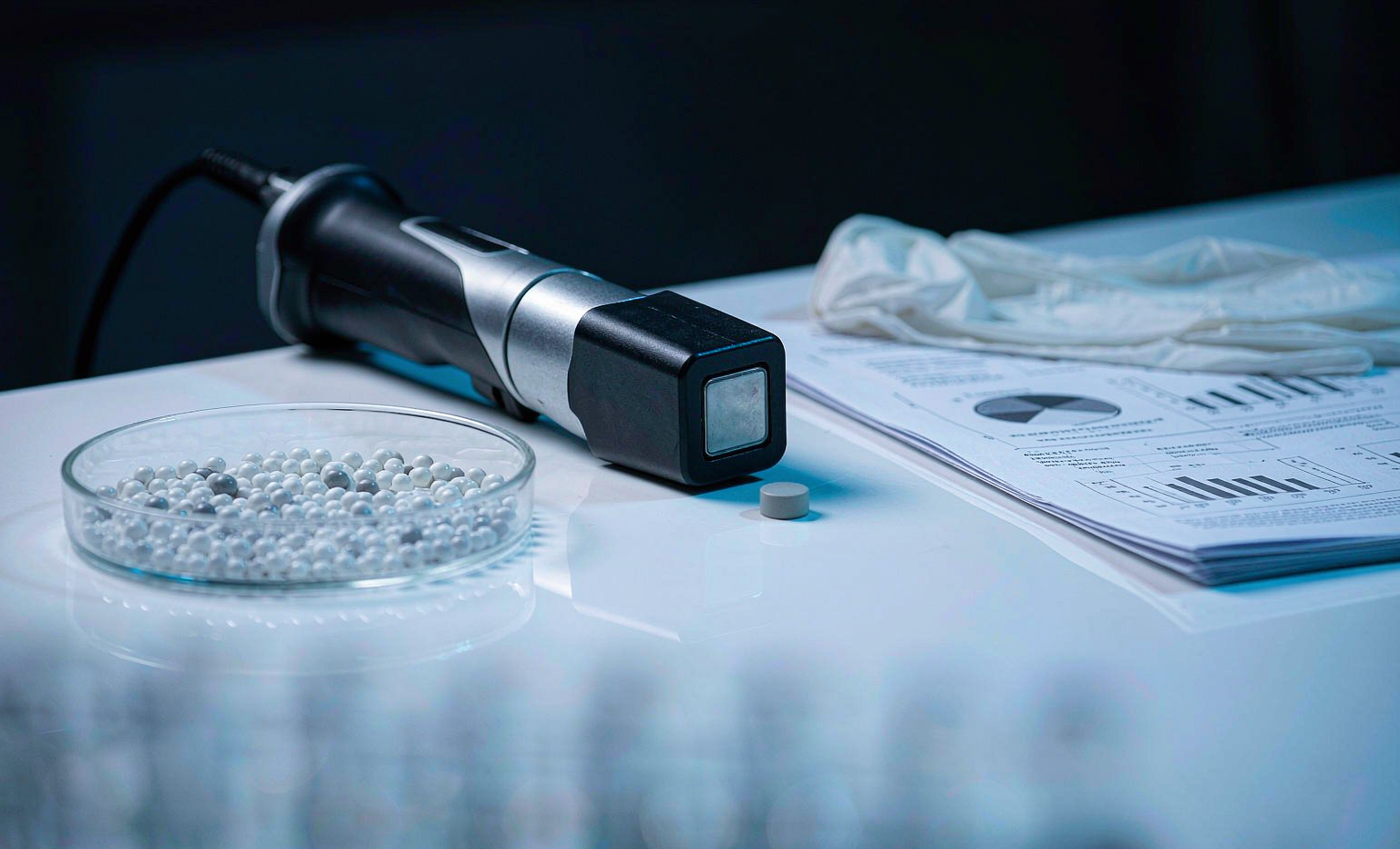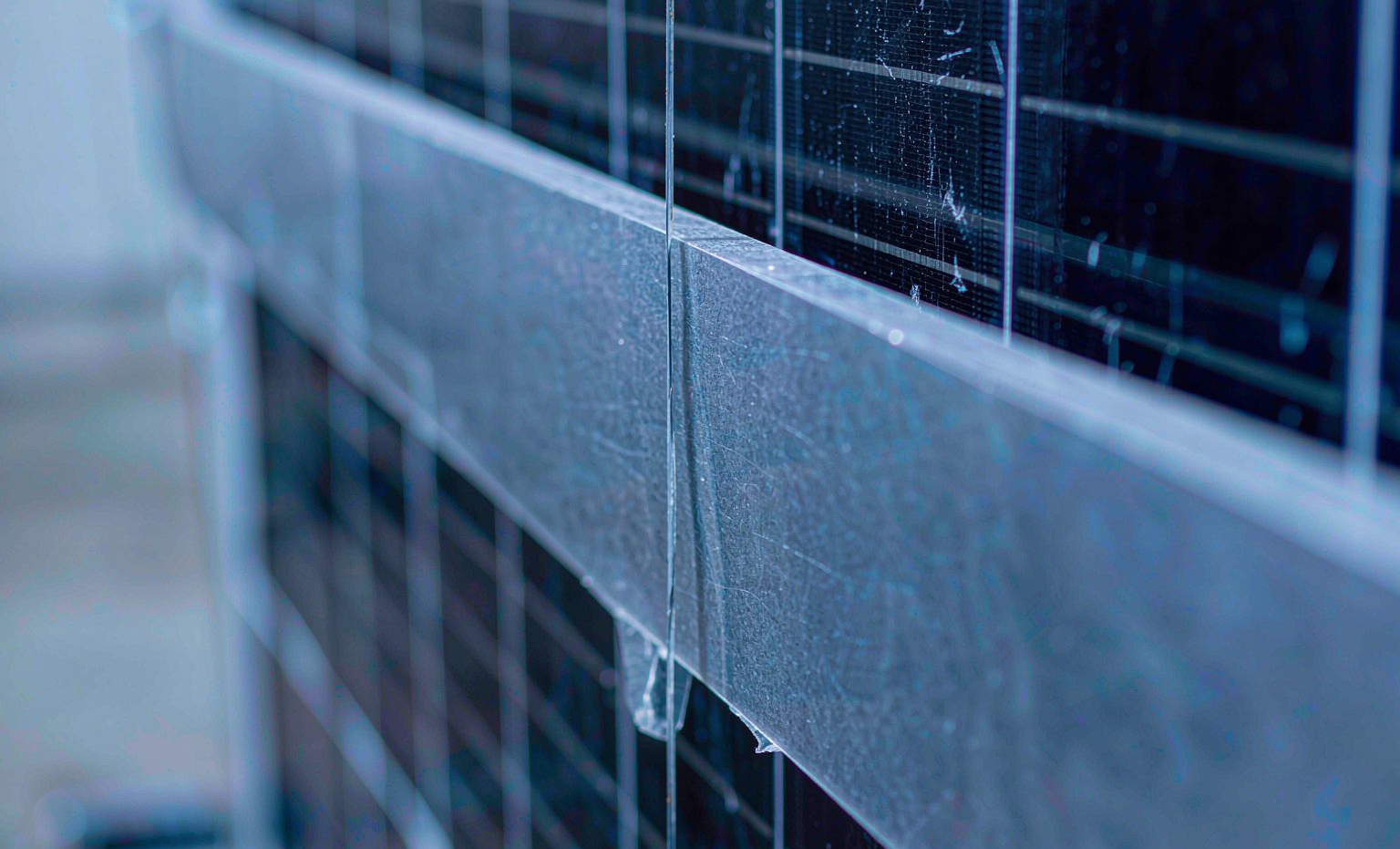
A photovoltaic module is a stack of expensive components held together by a layer most buyers never see. At roughly the thickness of a few sheets of paper, the encapsulant film has to transmit light, bond glass to cells to backsheet, insulate at system voltage, cushion thermal stress, and keep moisture and mobile ions away from the cell for decades. Get it wrong and no cell-efficiency number survives the first damp-heat test. Three labels dominate the conversation — EVA, POE and EPE — but they are not three equivalent options. Two are resin chemistries; one is a film construction. This guide separates them, sets out which properties actually decide the choice, and lists the numbers that belong on an RFQ before anyone books a lamination trial.
Two chemistries, one film structure
The first sourcing mistake is treating the three abbreviations as a single menu.
- EVA is ethylene-vinyl acetate copolymer. The vinyl acetate (VA) content is the defining variable: it controls polarity, crystallinity, flexibility, adhesion and water uptake. Photovoltaic film grades sit in a higher-VA band than general-purpose EVA used for foam or hot-melt adhesives, and the exact figure belongs on the grade's TDS. We covered the wider VA / MFR / application logic in EVA Grades Selection Guide: VA Content, MFR and Applications.
- POE is a polyolefin elastomer — typically ethylene copolymerised with a higher alpha-olefin (butene or octene). It is non-polar and contains no acetate groups. The same family is used far beyond photovoltaics for impact modification and soft-touch compounds; see POE Elastomers: Applications and Selection Guide.
- EPE is not a polymer at all. It is a co-extruded multilayer film, conventionally an EVA / POE / EVA stack: POE in the core, thin EVA skins on both faces. It is a way of buying most of POE's barrier behaviour without paying for a full-POE sheet.
There is a second distinction that matters just as much: resin is not film. A pellet TDS tells you about the polymer and its additive package before lamination. The properties a module maker qualifies — peel strength, gel content, optical transmission after cure, yellowing after UV exposure — are properties of the finished, crosslinked laminate. POLYVALA lists resin grades, not finished encapsulant film; the film converter is the customer for those pellets.
What the encapsulant actually has to do
Six jobs, and several of them pull against each other:
- Optical coupling. High light transmission and low haze, so the cell sees the photons. Transmission must survive lamination, UV exposure and 25 years of thermal cycling, not just measure well on a fresh roll.
- Adhesion. Bond to glass on one face and to the backsheet (or a second glass sheet) on the other, with peel strength that persists after damp heat. Loss of adhesion delaminates the module; too much adhesion can make rework and edge trimming difficult.
- Electrical insulation. High volume resistivity and low ionic conductivity at system voltage, at operating temperature and humidity. This is the property most directly tied to potential-induced degradation (PID).
- Moisture and ion barrier. Keep water vapour out and slow the transport of sodium and other mobile ions from the glass towards the cell.
- Mechanical buffering. Absorb the mismatch in thermal expansion between glass, silicon, metal ribbons and backsheet, and cushion the cell against hail, handling and mounting loads without creep.
- Processability. Flow and crosslink inside a realistic lamination window, with a cure state that is reproducible from roll to roll and lot to lot.
Every number on the RFQ should map back to one of these six jobs. A datasheet full of values that map to none of them is not a specification, it is a brochure.
EVA: the workhorse, and where it runs into limits
EVA became the default because it does almost everything adequately at a low price, with a mature converting supply chain and a wide, forgiving lamination window. Its polar acetate groups give good adhesion to glass and backsheet, accept silane coupling agents readily, and allow a well-understood peroxide crosslinking system. A typical photovoltaic EVA compound is a formulated package — base resin plus peroxide crosslinker, silane adhesion promoter, UV absorber, hindered-amine light stabiliser and antioxidant — either pre-compounded by the resin supplier or blended by the film converter.
The acetate groups are also the source of the limitations. Under heat and moisture EVA can release acetic acid, which lowers the pH inside the laminate, can contribute to corrosion of metallisation and interconnects, and together with moisture and sodium ion migration accelerates PID under high system voltage. EVA is also comparatively polar, so it takes up more water than a non-polar polyolefin, and it needs a competent UV package to resist yellowing and loss of transmission. None of this makes EVA unsuitable — billions of modules use it — but it does mean EVA has a narrower margin in designs where voltage, humidity and cell sensitivity are all pushed at once.
Two practical consequences for buyers: the additive package is part of the grade, not an optional extra to be improvised at the line, and cure state matters. Gel content after lamination (commonly measured by solvent extraction) is a process control variable, not a marketing number; under-cured film creeps and delaminates, over-cured film can embrittle and lose adhesion.
POE: why higher-voltage and bifacial designs moved
POE removes the acetate chemistry from the encapsulant. That single change shows up on the datasheet as higher volume resistivity, lower water uptake and no acetic acid generation — the three reasons it is specified where PID margin is tight. Bifacial glass-glass modules, higher system voltages and cell architectures that are more sensitive to surface recombination or moisture are the usual drivers. Many of the POE grades used in film are the same ethylene-alpha-olefin elastomer family documented in our POE selection guide, but a photovoltaic film grade is selected for a much narrower set of optical, rheology and additive requirements than a general compounding grade.
The trade-offs are real and mostly on the converting line:
- Adhesion is harder. A non-polar polyolefin does not bond to glass as readily as EVA, so coupling chemistry, surface treatment and laminate recipe become critical qualification items rather than assumed defaults.
- Cure and lamination window. Peroxide crosslinking efficiency, cure speed and flow differ from EVA; a recipe tuned for EVA cannot simply be reused. Narrower windows mean more scrap during ramp-up.
- Handling. Soft elastomeric film can be prone to blocking, roll telescoping, slip and thickness variation if storage and winding are not controlled.
- Cost and availability. POE resin commands a premium and supply is concentrated in fewer producers, so dual-sourcing and lead time belong in the commercial discussion from day one.
In short: POE buys electrical and moisture margin, and pays for it in adhesion engineering, process development and material cost.
EPE: the co-extruded middle path
EPE is a film construction designed to keep the useful part of each chemistry. The thin EVA skins preserve the familiar adhesion to glass and backsheet and fit existing lamination recipes; the POE core supplies the high-resistivity, low-water-uptake barrier where it matters electrically. Because the POE layer is only part of the total thickness, the material cost sits between full EVA and full POE.
The failure modes are specific to a multilayer structure and should appear in a qualification plan:
- Interlayer adhesion. The EVA/POE interface must survive lamination, thermal cycling and damp heat without delaminating. Ask for peel data across the layer interface, not only at the glass interface.
- Layer ratio and uniformity. A core that is too thin, or that thins out at the edges, quietly removes the PID benefit. Thickness tolerance and layer distribution are grade-level specifications.
- Edge ingress. A POE core does not help if moisture enters around the module edge; edge seal design and edge deletion quality still matter.
- Converting capability. Co-extrusion requires compatible melt rheology between layers. Not every film line can hold the layer structure at production speed.
- Regrind and trim. Mixed-layer scrap cannot be treated as clean single-resin regrind, which affects yield calculations.
EPE is best understood as a costed compromise, not a free upgrade: it gives a module designer a way to buy PID headroom while keeping the lamination process closer to the EVA baseline.
Side-by-side: the properties that actually decide
This table is a selection orientation, not a specification. Every property below is grade-specific, formulation-specific and test-method-specific; confirm the values and their conditions on the current TDS and the converter's qualification report.
| Decision factor | EVA film | POE film | EPE (EVA/POE/EVA) |
|---|---|---|---|
| Chemistry | Polar ethylene-vinyl acetate | Non-polar polyolefin elastomer | Co-extruded multilayer; both chemistries |
| PID / electrical margin | Baseline; acetate and ion transport reduce margin at high voltage | Strongest: high resistivity, no acetic acid | Intermediate to strong, set by core thickness and quality |
| Moisture behaviour | Higher water uptake; hydrolysis can release acetic acid | Low water uptake | Low in the core; EVA skins still polar |
| Adhesion to glass / backsheet | Naturally good with silane promoters | Needs deliberate coupling and recipe work | Good via EVA skins; interlayer bond is the new risk |
| Lamination / cure window | Wide, well understood, most tolerant | Narrower; recipe changes usually needed | Close to EVA, with co-extrusion constraints upstream |
| UV / yellowing | Depends heavily on UV absorber and HALS package | Generally stable; still needs stabilisation | As per skins plus core package |
| Material cost | Lowest | Highest | Between the two |
| Typical fit | Glass-backsheet, conventional voltage, cost-led programmes | Glass-glass, bifacial, high voltage, PID-sensitive cells | Bifacial or high-voltage designs needing cost control |
| Qualification burden | Lowest; established test history | Highest; new adhesion and cure validation | Adds interlayer and layer-ratio validation |
Indicative family-level tendencies only. A well-formulated EVA can outperform a poorly formulated POE in a given test; the laminate and the exact grade decide. Our guide to reading a TDS and COA explains why a value without its test method and condition is not evidence.
Match the film to the module design
Start with the module architecture, not the resin catalogue.
- Glass-backsheet, standard system voltage, cost-led volume programme: EVA remains the rational default. Spend the engineering effort on the UV package, cure control and damp-heat peel retention instead of paying for barrier performance the design does not need.
- Bifacial glass-glass, high system voltage, or PID-sensitive cell architectures (TOPCon, HJT and similar): POE or EPE. Both sides of a bifacial module are exposed, and higher string voltages increase the electrical stress that drives PID. The relevant evidence is module-level PID test data, not a resin resistivity figure alone.
- Hot-humid, coastal or desert deployment: moisture ingress, hydrolysis and thermal cycling dominate. Compare water vapour transmission, acetic acid behaviour, adhesion retention after damp heat, and UV dose for the intended climate.
- Lightweight, BIPV, flexible or specialty modules: treat as a separate qualification exercise. Substrate, thickness, curing temperature limits and optical requirements can rule out all three standard routes.
Ultimately the module, not the film, is what gets certified. Design qualification and safety testing under IEC 61215 and IEC 61730, and PID testing under IEC TS 62804-1, are the acceptance gates; confirm which revisions and which test conditions your customer and destination market require. A resin TDS cannot substitute for any of them.
The numbers to ask for - and the method behind each
A useful specification pairs every value with its test method, conditioning and sample state (film as delivered, or film after lamination and cure).
- Resin identity: polymer type, and for EVA the VA content with its determination method; MFR with the temperature and load (ISO 1133), density (ISO 1183), melting / crystallisation behaviour by DSC, and the additive package declaration.
- Optical: light transmission and haze, commonly to ASTM D1003, on the laminated film; yellowing index (ASTM E313 or an agreed equivalent) before and after UV and damp-heat exposure.
- Electrical: volume resistivity at specified temperature and humidity; dielectric strength if the design calls for it.
- Barrier: water vapour transmission rate with the test condition stated, because the number is meaningless without temperature and humidity.
- Adhesion: 180-degree peel strength against glass and against the actual backsheet, measured after lamination and after damp heat, UV and thermal cycling retention — not just the initial value. The chemistry behind durable adhesion to dissimilar layers is the same one used for tie-layer and adhesive resins in multilayer packaging.
- Cure state: gel content and its extraction method, plus the lamination temperature / time / pressure window that produces it reproducibly.
- Reliability: PID power loss under the agreed stress conditions, and property retention after the ageing sequence in the applicable IEC test programme.
- Handling: thickness and tolerance, roll width, blocking, shelf life, packaging moisture barrier, storage temperature range and usable time after opening.
Why so insistent on method? Because two suppliers can both write “90 % transmission” or “peel strength 60 N/cm” while measuring different sample states at different conditions. A datasheet states typical values; a COA states what one production lot actually did. Knowing which document answers which question — and which six numbers to verify on arrival — is the subject of How to Read a TDS and COA.
Five mistakes that cost a lamination trial
- Buying “photovoltaic grade EVA” with no VA or MFR window. Two pellets sold under that phrase can have different polarity, flow and cure behaviour. Put the range and the method on the RFQ.
- Assuming the pellet TDS predicts the laminate. Additive package, film extrusion, storage and lamination all change the final properties. Qualify the film, not just the resin.
- Ignoring shelf life and storage. Crosslinker and silane systems age. Moisture-proof packaging, storage temperature, first-in-first-out rotation and time-after-opening limits are part of the specification, not warehouse trivia.
- Testing only initial peel strength. Most field delamination appears after damp heat and thermal cycling. Retention is the number that matters.
- Running a single-condition PID check. Voltage polarity, magnitude, humidity, temperature, duration and whether the module is bifacial all change the outcome. Match the test to the field configuration.
What belongs on the RFQ
A supplier can only quote accurately against a defined requirement. Include at minimum:
- Whether you are buying resin pellets or finished film — these are different supply chains and different specifications.
- Route and structure (EVA / POE / EVA-POE-EVA), and whether alternatives are acceptable.
- For EVA: VA content and tolerance; for POE: comonomer type, density and MFR window.
- Target film thickness and tolerance, roll width, and the additive package (pre-compounded or separately supplied).
- Lamination window, target gel content and the method used to measure it.
- Acceptance values for transmission, haze, volume resistivity, WVTR, and peel strength before and after ageing, each with its test method.
- PID test conditions and the acceptance criterion; the IEC test programme and revision the module must pass.
- Packaging, shelf life, storage conditions, lot traceability and a sample COA from a real production lot.
- Annual volume, samples needed, target packing, incoming-inspection plan and required compliance documents for the destination market.
For the wider commercial checklist — MOQ, samples, freight and packing — see Sourcing Polymer Pellets from China: MOQ, COA, Samples and Freight Explained. The acronym jungle around EVA, POE, OBC and friends is untangled in Resin Abbreviation Bingo.
Where POLYVALA fits
POLYVALA works on the resin side: matching a buyer's requirement to a documented grade across producers, and supplying the grade-level paperwork that makes an incoming inspection possible. The categories relevant to this discussion are polyolefin polymers (EVA) and polyolefin elastomers (POE); both can be filtered by producer, density, MFR and melting point in the all-grades comparison table, or browsed in the main catalogue. We do not manufacture encapsulant film, and we do not present a resin TDS as if it were a module qualification report.
If a property is not on the current TDS, we say so rather than filling the gap with a plausible number. Our Data Sources & TDS Request Policy sets out where the figures on this site come from and how to request the original document for a grade.
Frequently asked questions
Is EPE a different polymer?
No. EPE is a co-extruded film with EVA outer skins and a POE core. The chemistry is EVA plus POE; the novelty is the layer structure and the converting process that produces it.
Does switching to POE eliminate PID?
No. POE improves the encapsulant's contribution to PID resistance, but PID is a system-level failure mode influenced by cell type, system voltage and polarity, glass and sodium ions, edge sealing, humidity, temperature and grounding. It has to be demonstrated at module level under the agreed test conditions.
Can I qualify a film from the resin TDS alone?
No. A resin TDS covers the polymer and its declared additive package before converting. Peel strength, gel content, transmission after cure, yellowing and PID behaviour are laminate-level properties that need film or module testing.
Why does VA content matter so much for EVA?
VA content sets polarity and disrupts crystallinity. It moves adhesion, flexibility, softening behaviour, water uptake and compatibility with the crosslinking package together — which is why “EVA” without a VA figure is not a usable specification.
Which route is cheapest?
On resin price, EVA. On cost per accepted module, it depends: POE and EPE can pay for themselves if they avoid PID field failures, or waste money if the design never needed that margin. Compare scrap rate during ramp-up, cure cycle time, adhesion-engineering cost and qualification effort, not just pellet or roll price.
Need help shortlisting a grade?
Send us the module architecture, the properties you must hold and the test methods you use, and we will come back with a shortlist and the supporting documentation rather than a single number. Request a quote or technical datasheet, or review the full grade table to see what is currently listed.
This article is general selection guidance. Property statements are indicative family-level tendencies, not a specification or warranty for any grade; always confirm values, test methods and compliance on the supplier's current TDS and lot-specific COA, and qualify the finished laminate at module level before release to production.
Related Products
- Dow ENGAGE 8150 (POE elastomer)
- Wanhua WANSUPER 5007 (POE)
- SABIC FORTIFY C0570 (POE)
- LG Chem LUCENE LC670 (POE)
- Mitsui TAFMER A-4050S (POE)
- ExxonMobil Exact 5171 (plastomer)
About This Article
This guide is prepared by the POLYVALA technical team. All property values, test methods and compliance statements are drawn from manufacturer Technical Data Sheets (TDS) and recognized standards (ASTM, ISO). Figures must always be confirmed against the current official TDS and the lot-specific Certificate of Analysis (COA) before production qualification.
References
- Manufacturer Technical Data Sheets (TDS) for the grades referenced above.
- ASTM D1238 / ISO 1133 — Melt flow rate (MFR/MFR) of thermoplastics.
- ASTM D1505 / ISO 1183 — Density of plastics by the density-gradient technique.
- ASTM D638 — Tensile properties of plastics.
Related reading
For a five-brand POE comparison — Dow ENGAGE, ExxonMobil Exact, Mitsui TAFMER, Borealis Queo and LG Chem LUCENE — see our POE Grade Map.
About this article
Written by the technical team at Shanghai Polyvala Plastics, a sourcing and compounding partner for specialty polymer buyers since 2013. We check grades against manufacturer TDS and lot-specific COA rather than marketing claims. Questions about a grade or an equivalent? Request the TDS and COA, or contact our application engineers for a line-specific recommendation.
Application case studies