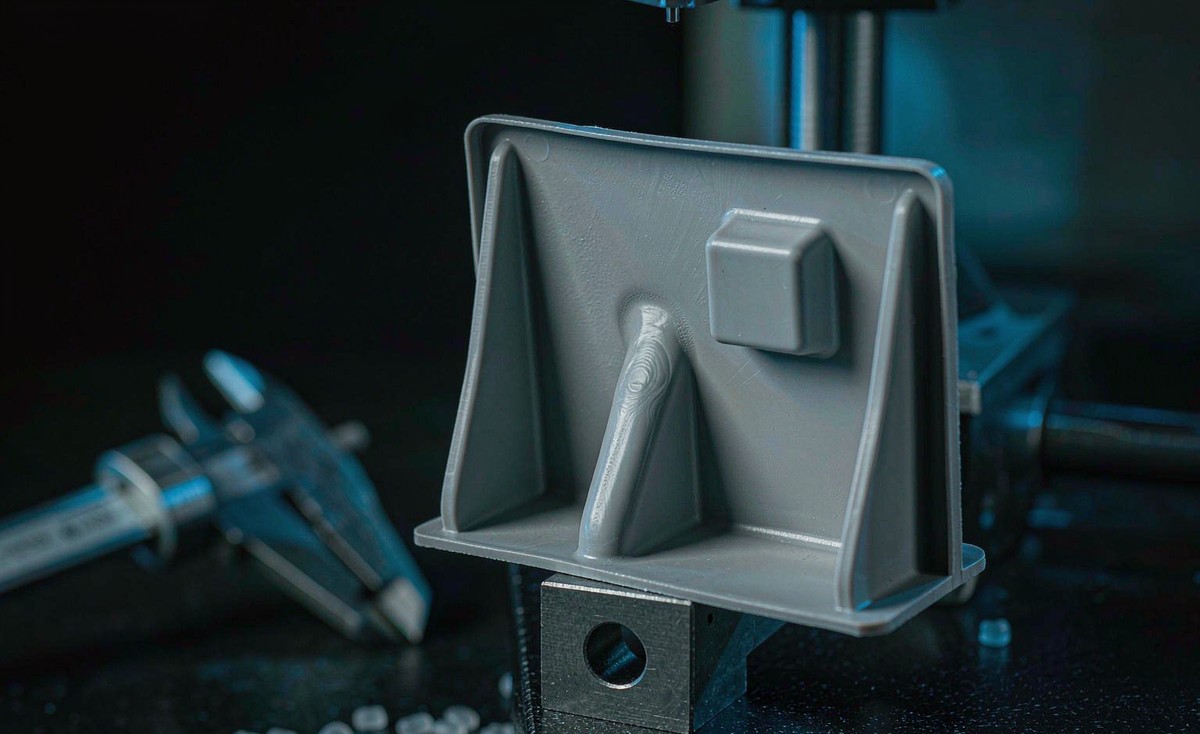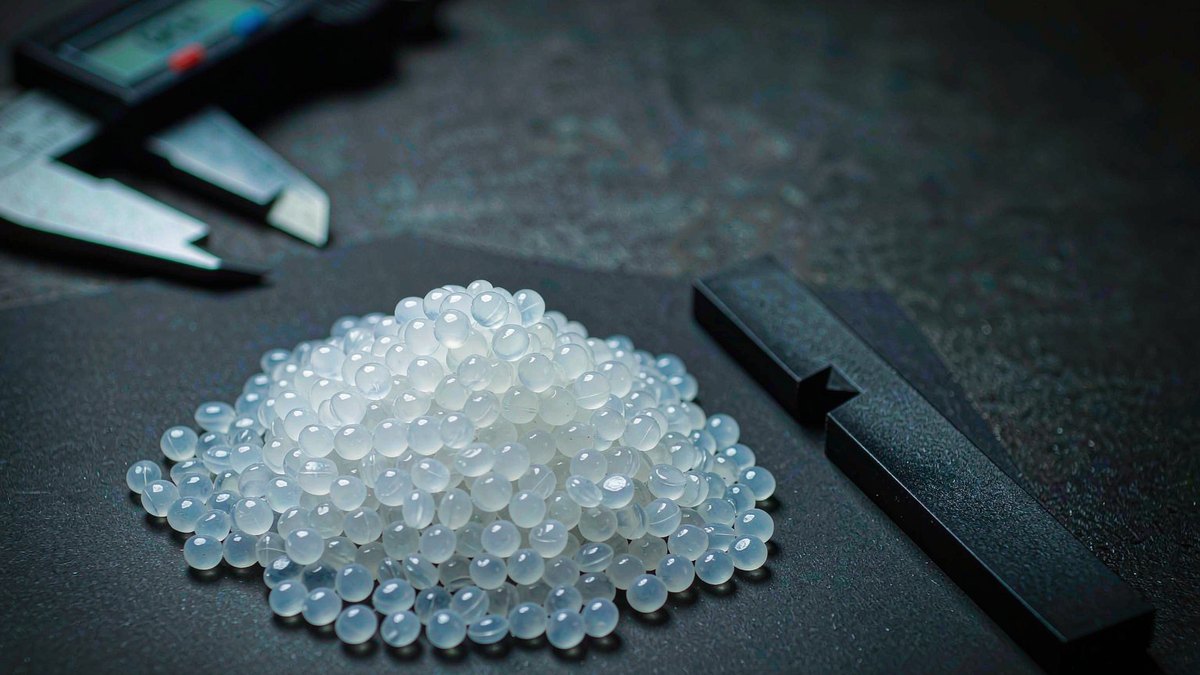
Search for how much POE to add to PP and you will land somewhere between 5% and 30%. Every one of those numbers comes from real practice. The gap is not an error — it is a missing premise. This note lays out the premises so you can place your own system on that range instead of guessing.
The situation
A compounder is asked to stop a PP part from cracking in a drop test, or a buyer is told “just add ten percent POE” by a supplier who has never seen the part. Both end up in the same place: a loading number with no context, followed by a trial that either overshoots stiffness or undershoots impact.
The number itself is not the decision. The decision is which constraint you refuse to give up, because POE loading trades directly against stiffness, flow and cost.
The three variables that actually set the number
Base resin
Homopolymer PP is stiffer and more brittle; copolymer PP already contains ethylene segments, so each percent of POE buys more impact. Published compound patents and technical guides consistently work in a higher POE window for homopolymer systems and a lower one for copolymer systems, for the same target impact. If someone quotes you a single number without asking which PP you run, the number is not about your part.
Target property
“Survives a −20 °C drop” and “keeps flexural modulus above a floor” pull in opposite directions. The first pushes loading up, the second caps it. Written specifications rarely state which of the two is the real constraint, so the loading number floats.
POE grade itself
Density and comonomer content decide how soft the elastomer is at a given loading. Low-density octene grades (around 0.857–0.870 g/cm³) deliver impact efficiency and low-temperature toughness, and give up more stiffness per percent added. Higher-density grades (0.880–0.908 g/cm³) behave more like a plastomer: less efficient per percent, but they hold modulus better. Two compounders using “15% POE” can end up well apart in actual modulus simply because one used 0.884 and the other 0.868.
What the common practice costs
- Fixating on a number. Copying “20%” from a forum post usually means over-toughening a copolymer system and losing modulus you did not need to lose — or under-toughening a homopolymer and failing the same drop test twice.
- Ignoring the dispersion step. Loading only works if the elastomer is dispersed into fine domains. Poor mixing at 25% behaves worse than good mixing at 15%, and the failure looks like “POE does not work in our line”.
- Adding POE to fix a moulding problem. Weld lines, gate freeze-off and shrinkage are process symptoms. More elastomer raises viscosity and can make all three worse.
- Using a masterbatch without re-checking the let-down. Masterbatch is the right route at low loadings, but the carrier resin becomes part of your formulation and shifts the balance.
How we set the loading
We start from the constraint that is hardest to recover. Stiffness lost to elastomer is difficult to buy back without filler or a higher-modulus base resin; impact that is short can usually be recovered by adding more, at a cost. So we fix the constraint first and solve loading around it:
- Measure the base resin as received — modulus, notched Izod at the service temperature, MFR.
- Decide which one is non-negotiable: modulus floor, low-temperature impact, or cycle time.
- Choose density first, loading second. Density sets the slope; loading moves you along it.
- Run a three-point ladder (low / mid / high inside the expected window) rather than a single point. The curve is rarely linear near the brittle–ductile transition.
Reference ranges (premises included)
The table below reflects publicly discussed practice and published compound patents, not our test results. Treat it as a starting window for a trial, not a specification.
| Situation | Commonly cited loading | What binds |
|---|---|---|
| Copolymer PP, moderate room-temperature impact target | roughly 5–15 wt% | Stiffness drift and surface gloss |
| Homopolymer PP, low-temperature impact required | roughly 15–30 wt% | Modulus loss, flow drop, cost per kg |
| Thin-wall or long-flow parts | lower end of the window | Weld line strength, fill pressure |
| Highly filled systems (talc, CaCO3) | mid window, higher-density grade | Filler acceptance vs impact efficiency |
Published compound patents for high-toughness PP compositions typically place copolymer PP at 65–85 wt% with POE at 10–25 wt%, plus optional talc up to about 10 wt%. Vendor application notes for low-density octene grades describe 15–25 wt% in PP bumper compounds as a common working range. Both are consistent with the table above — they simply sit on different premises.
Grades to start a trial with
If stiffness retention is the binding constraint, start from a higher-density grade: Dow ENGAGE 8003 (0.885 g/cm³, MFR 1) or Dow ENGAGE 7270 (0.880, butene-based).
If low-temperature impact is the binding constraint, compare a low-density octene grade: Dow ENGAGE 8842 (0.857, MFR 1) against a general-purpose 0.868 grade such as Dow ENGAGE 8157. All four come with TDS and COA, and we can quote alternate producers in the same density and MFR band.
Whichever loading window you pick, the grade inside it decides how much stiffness you keep — see How POE density affects stiffness retention in toughened PP.
FAQ
Is more POE always better for impact?
No. Impact rises steeply past the brittle–ductile transition, but so does the modulus penalty, and above a certain loading the elastomer phase becomes continuous or co-continuous and the part stops behaving like PP.
Can I add POE directly, or do I need a masterbatch?
Direct addition works from roughly 10% upward with proper twin-screw feeding. Below that, a masterbatch gives better dispersion control; remember that the carrier resin joins your formulation.
Does POE change drying or processing?
POE is non-hygroscopic and does not need drying. What changes is melt viscosity and screw torque — expect to adjust the temperature profile and output, not the dryer.
How do I qualify a substitute POE grade?
Match density and MFR first, then comonomer type, then run a three-point ladder on your own base resin. Same-density grades from different producers are not drop-in equivalents until the impact curve is confirmed.