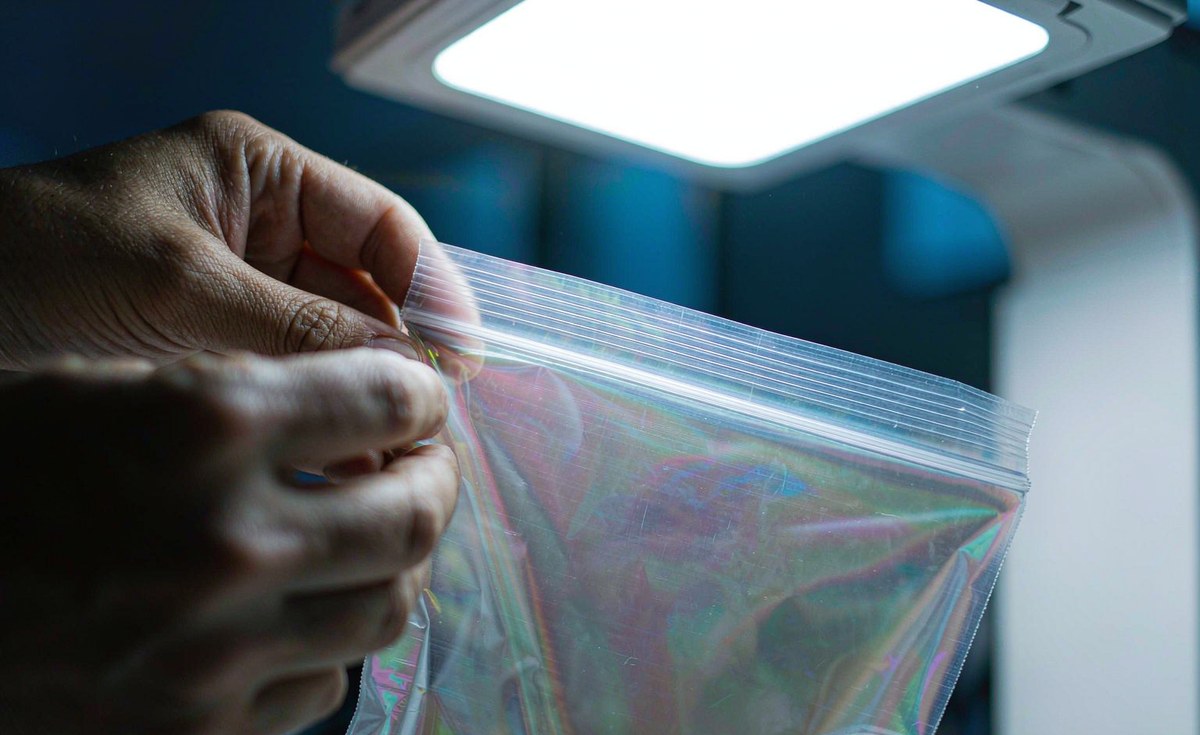
A packaging line starts producing bags with seams that leak, split at the jaw, or peel open in the customer's hand. The film has not changed, the resin certificate has not changed, and the line was running fine yesterday. Seal failure is rarely one problem — it is a chain with four links: the sealant layer, the heat history, the surface it has to stick to, and the test used to judge it. This note walks the four links in the order we check them, so you can stop changing variables at random.
The situation
A converter calls about "bad seals" and usually means one of three different failures. They need to be separated first, because each points to a different fix:
- Peel / weak seal. The two layers separate cleanly at low force. The sealant never developed enough adhesion or heat.
- Brittle fracture at the jaw. The seal cracks right at the edge of the heated area, often with a clean line. This is usually heat damage or a sealant that is too broad-melting for the jaw temperature.
- Delamination next to the seal. The seal itself holds, but the layer next to it splits. The problem is the tie layer or layer compatibility, not the sealant.
Changing resin before naming which of the three you have is the most expensive route. Most "we changed the sealant and it got worse" stories are really a temperature problem wearing a resin costume.
The four variables that actually move the result
Sealant chemistry
EAA/EMAA, ionomer and EMA/EBA all seal, but they do it for different reasons. EAA and ionomer build strong polar adhesion and are forgiving of contaminants; EMA/EBA are softer and seal at lower temperatures with a wider window but give lower hot-tack and seal strength. If the line runs a dirty or recycled surface, the polar grades buy you margin that EMA alone cannot.
Melt flow and seal initiative
MFR changes how fast the sealant wets the opposing surface at a given jaw temperature. Higher-flow grades reach wet-out sooner and tolerate shorter dwell; lower-flow grades need more heat or time. Published supplier data for EAA sealant grades, for example, spans roughly MFR 7 to 14 at similar density — a real difference in how a line behaves at the same settings.
Heat history at the jaw
Seal strength rises with temperature only up to a point, then falls as the sealant and the layer beneath it degrade. The useful window is bounded by two temperatures: enough to melt and wet, not enough to burn. A line that has drifted 10–15 °C hotter can move from the top of the window into degradation without anyone changing a setpoint on purpose — a fouled heater band or a changed line speed is enough.
The opposing surface and the test
Sealing PE to PE, to EVOH-based barrier structures, or to a printed or treated surface are three different jobs. And "the seal passes" depends on the test: a room-temperature peel, a hot-tack measurement and a drop test after conditioning rank the same film differently. Specify the test and the conditioning before you change material.
What the common practice costs
- Turning up the heat. It fixes weak seals immediately and quietly reduces the window, increases neck-in and smoke, and damages heat-sensitive layers. It is a valid diagnostic, not a production setting.
- Blaming the grade first. Switching sealant restarts qualification, printing and regulatory checks. A jammed heater or a changed nip pressure is cheaper to rule out.
- Ignoring the layer next to the seal. A strong seal bonded to a weak tie layer fails right beside the seal and looks identical to a seal problem from the outside.
- Reading the label, not the lot. "EAA" covers a broad family. Two EAA grades at the same comonomer level can differ enough in MFR to change the line window.
How we narrow it down
We work from the outside in: confirm the failure mode, confirm the machine, then confirm the material. The order matters because each step rules out a class of causes before you spend money on the next.
- Read the seam. Peel a failed seal by hand and look at where it splits — in the sealant, at the jaw edge, or one layer away. Photograph it before adjusting anything.
- Map the jaw. Measure actual bar temperature across the width, not the controller setting. Check dwell and pressure at the same time; a pressure drop mimics a temperature drop.
- Check the surface. Confirm treatment level and surface cleanliness on the opposing web, especially if recycled content or a new print lot is involved.
- Only then compare grades. Match on chemistry family first, then MFR band, then test on your own film structure — a resin that seals well in a PE/PE structure can behave differently against a barrier layer.
Reference starting points (with premises)
The ranges below reflect publicly discussed packaging practice and published supplier data, not our own test results. They are starting windows for a trial, not specifications. Confirm against the current official TDS and validate on your own line.
| Situation | Where to start | What binds |
|---|---|---|
| Clean PE-to-PE seal, general purpose | EAA or EMA/EBA sealant; mid MFR band | Hot-tack and seal initiation vs neck-in |
| Contaminated or recycled surface, or high seal strength required | Ionomer or EAA | Cost, and seal strength vs peelability requirement |
| Low sealing temperature / heat-sensitive substrate | Lower-MFR EMA/EBA or a lower-seal-initiation grade | Seal strength ceiling and hot-tack |
| Multilayer film with EVOH or PA barrier | Check the tie layer before the sealant | Interlayer adhesion, not just seal strength |
Grades worth putting on the trial sheet
EAA family. SK Chemical 3440 (PRIMACOR EAA) is a mid-flow, ~0.938 g/cm³ EAA at MFR 10 — a reasonable general-purpose sealant candidate. SK Chemical 3003 sits at a similar density (~0.935) but lower MFR (~7.8), useful when a slower, stronger seal is preferred.
Ionomer family. Dow SURLYN 1652 (~0.94 g/cm³, MFR ~5.5) is the polar, high-seal-strength route for demanding surfaces; Dow 1702 (~0.95, MFR ~14) offers a higher-flow option when faster wet-out matters more.
EMA/EBA family. SK Chemical 20MA08 (LOTRYL EMA) (~0.94, MFR 8 at 190 °C/2.16 kg) is a lower-temperature sealing candidate when heat sensitivity dominates.
Why these fall out of the serious shortlist and how to read the numbers is covered in our Surlyn ionomer grade map and EAA/EMAA adhesive resin guide. For the wider packaging context see our film structures comparison.
FAQ
Why did the seals fail only after we changed line speed?
Speed changes dwell time at the jaw. A seal tuned at a slower speed may not reach wet-out at a higher one, and the fix is usually dwell or temperature, not a different resin.
Does a higher seal temperature always mean a stronger seal?
No. Strength rises to a peak and then falls as material degrades. Run a seal-strength-versus-temperature curve and work in the middle of the plateau, not at the highest setting that still sticks.
Can I seal over printing or a treated surface?
Sometimes, but inks, coatings and treatment level change the surface energy. Polar sealants such as EAA and ionomer are more forgiving; validate on the actual printed web, not a control film.
When should I suspect the tie layer instead of the sealant?
When the seal itself holds but the adjacent layer peels away. In EVOH or PA barrier structures, a tie-layer problem is often diagnosed as a seal problem. Check the layer where the split actually runs.
Which test should I qualify with?
Use the test and conditioning your customer specifies. Room-temperature peel, hot tack and a conditioned drop test rank films differently, so a pass in one is not proof in another.